Negotiations often go wrong before the participants even sit down at the table.
Not because of a bad offer. Not because of an aggressive supplier. And usually not because the planets happen to be badly aligned.
The reason tends to be much less poetic: no one really knows what they want to achieve.
The team walks into the negotiation with a few spreadsheets, a vague idea of getting a better price, and a determination to “do something about it.” Then the meeting starts, the other side asks the first uncomfortable question, and the original plan falls apart faster than a construction project budget after the bids are opened.
Negotiation is not improvisational theatre. It is a process. And if you are not managing it, chances are someone else is managing you.
Never Negotiate Without a Goal
The first rule sounds obvious: you need to know what you want.
But “better terms,” “a lower price,” or “somehow reaching an agreement” are not goals. They are wishes. Much like saying, “I’d like to exercise more this year.” Sounds good, but no one has lost weight because of it yet.
A useful goal needs to be specific.
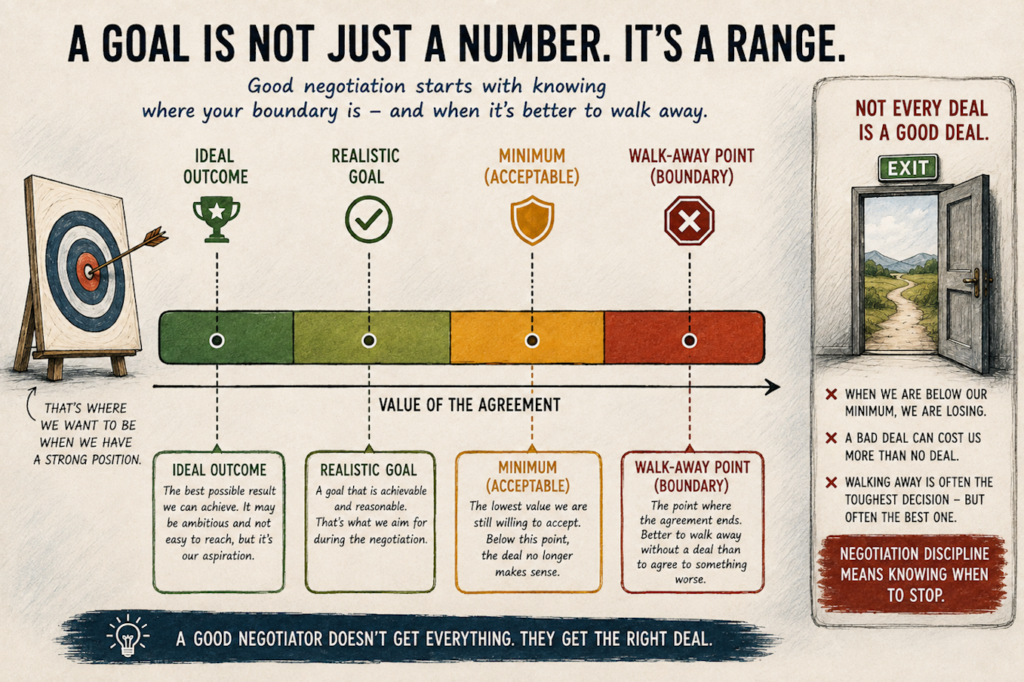
What outcome would we consider ideal? What would still be acceptable? Where is the line beyond which an agreement no longer makes sense? What can we offer in exchange? And what will we do if we fail to reach an agreement?
That last question is often overlooked. Yet without a genuine alternative, negotiation can quickly turn into begging.
If the other side knows that you need to sign the contract at any cost, they will notice. Maybe not from your opening words, but from every subsequent concession you make too quickly.
Urgency has a peculiar quality.
You can smell it across the table.
A Goal Is Not One Magic Number
Imagine a buyer entering a negotiation with the goal of reducing the price by fifteen percent.
The number is clear. At first glance, it seems like an ideal situation.
But what if the supplier offers a fourteen-percent reduction while also extending the warranty, shortening the lead time, or taking over part of the logistics costs? Is that a failure because we did not reach fifteen percent?
Of course not.
Clinging too tightly to a single number can narrow your perspective so much that you reject an excellent deal simply because it does not fit neatly into one box.
That is why it is more practical to work with a target range.
We should know our ambitious outcome, our realistic target zone, and our bottom line—the point below which it no longer makes sense to continue. At the same time, we need to know which terms genuinely create value for us and which merely look important in a presentation to management.
Price matters. But it is not the only thing that matters.
Quality, delivery times, service, capacity, liability, payment terms, contractual flexibility, risk, operating costs, and the supplier’s ability to solve a disaster at 4:30 on a Friday afternoon all come into play.
The last item rarely appears in evaluation models.
In practice, it can be surprisingly valuable.
Write Your Goal Down. Seriously.
It may sound a little school-like, but it works: write your main goal in big letters and keep it in front of you throughout the negotiation.
Not in your head. Not somewhere on slide seventeen. On a piece of paper in front of you.
Negotiations have a habit of changing direction. A new argument appears, someone makes a personal remark, an unexpected offer lands on the table, or a long discussion begins about something that was not particularly important in the first place. Suddenly, the team is fighting over something nobody cared about an hour ago.
A typical example?
During the negotiation, the supplier challenges the buyer’s historical purchasing data. The buyer feels attacked and spends the next forty minutes defending the accuracy of the report. By the end, they may have achieved a moral victory over a pivot table, but made absolutely no progress on the commercial terms.
A clear goal keeps attention where it belongs.
It is a simple safeguard against letting ego, emotion, or some technical detail that has inexplicably decided to become the main character of the day take over the negotiation.
Strategy Comes Before Tactics
Once we know what we want to achieve, we need to decide how we intend to get there.
Will we push? Collaborate? Look for value trades? Postpone certain issues? Make a concession? Or would we rather walk away?
There is no universally correct strategy.
A tougher approach may work with a standardised commodity where plenty of alternative suppliers exist. With a partner who controls critical know-how, capacity, or service infrastructure, the same approach may do more harm than good.
Procurement often celebrates toughness. But almost anyone can apply pressure. The much harder skill is knowing when pressure helps and when it simply makes our own position worse.
Strategy must be based on reality.
How strong is our position? How strong is the supplier’s? What alternatives do we have? How long is the relationship supposed to last? What is the cost of no agreement? What can the other side gain elsewhere? And what do we stand to lose?
Without answers to these questions, we are not being strategic.
We are simply trying different facial expressions and waiting to see which one works.
No Deal Is Better Than a Bad Deal
One of the most dangerous sentences in procurement is: “We have to reach some kind of agreement.”
No, we don’t.
Sometimes we genuinely need to secure supply quickly. Sometimes our alternatives are far from ideal. Sometimes the deadline is breathing down our neck and the internal customer is calling every nine minutes.
Even then, simply closing a deal is not a success in itself.
A bad agreement can mean an unfavourable price, unacceptable risks, unrealistic deadlines, problematic liability, or terms that will keep Legal, Operations, and management busy long after the contract has been signed.
The contract is signed. The system shows green. Everyone breathes a sigh of relief.
Three months later, we discover that we have purchased an expensive problem with automatic renewal.
Good preparation must therefore include a walk-away point: the boundary beyond which we decide that the agreement no longer makes sense under the current conditions.
Not as a threat.
As a decision.
Most Teams Overprepare Their Arguments and Underprepare Their Tactics
Before an important negotiation, someone usually creates a presentation.
It contains charts, indices, historical trends, market comparisons, volumes, forecasts, and several slides whose author has already forgotten why they were included in the first place.
The team feels prepared.
But preparing arguments is only part of the job.
It is equally important to think through how the negotiation itself will unfold.
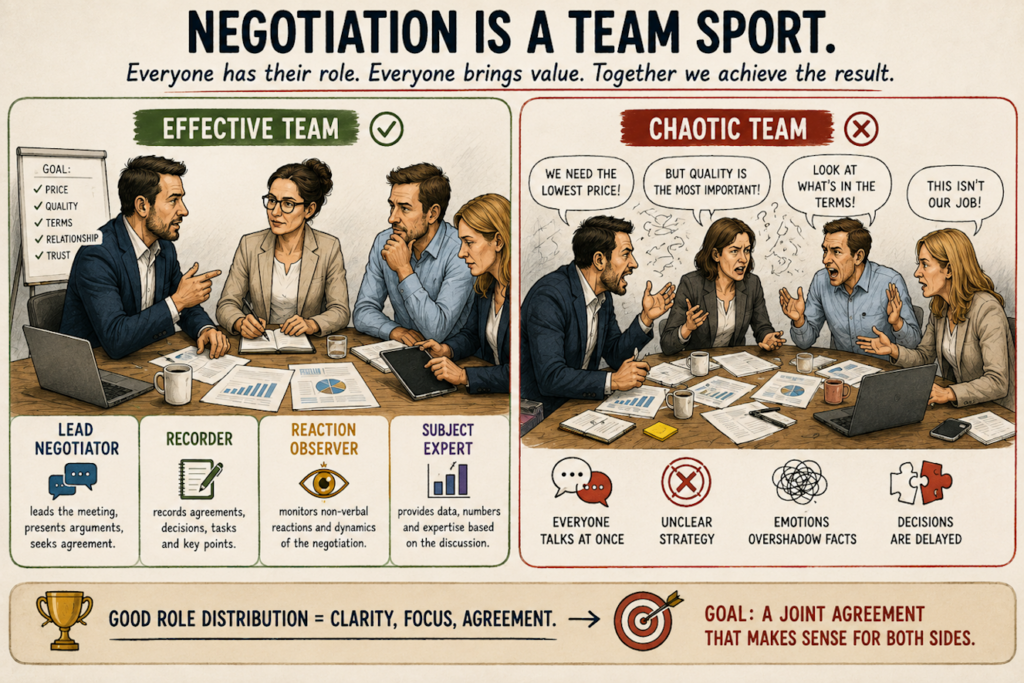
Who will open the meeting? Who will present the demand? Who will ask questions? Who will take notes? Who will monitor the other side’s reactions? Who will step in if things begin to escalate? And who will make sure the technical expert does not perform a live autopsy on your own negotiating position?
Because that happens.
The expert is given the floor to explain a technical requirement. The other side asks a clever question. The expert gets excited and, over the next ten minutes, explains that the requested solution is not actually essential, that a cheaper alternative exists, and that the deadline could probably be moved.
The supplier thanks them for their transparency.
Meanwhile, the buyer quietly ages.
Don’t Go Into a Complex Negotiation Alone
One person cannot handle everything during a demanding negotiation.
They have to talk, listen, watch reactions, keep the objective in mind, record terms, notice concessions, manage the time, and simultaneously think about the next move.
That is not a sign of competence.
It is a recipe for missing half the important signals.
A well-structured team divides the roles.
One person leads the negotiation. Another monitors the content and takes notes. A third watches the other side’s reactions—including who withdraws when a certain topic comes up, who suddenly starts talking, and who abruptly develops a deep interest in the grain of the wooden table.
Silence within the team has a purpose too.
The person who is not speaking can often see much more than the person currently explaining the pricing model.
That does not mean eight people need to attend every meeting. A negotiation delegation is not a school trip. The number of participants should reflect the importance and complexity of the situation.
But in critical negotiations, a second pair of eyes can be extraordinarily useful.
Roles Must Be Clear in Advance
A team without clearly assigned roles often starts negotiating with itself.
One person pushes on price. Another tries to protect the relationship. A third promises technical concessions, while a fourth has only just discovered that the meeting actually has an objective.
The other side barely has to do anything.
They just need to listen.
Before the meeting, everyone must know who is authorised to offer a concession, who can approve a technical change, and which points require further approval.
It is equally important to agree on internal signals.
When will the team take a break? How will they alert the lead negotiator that they have missed a risk? How do you stop a colleague who has decided to save the meeting with a lengthy monologue?
Taking a break is not a weakness.
Saying, “We need a few minutes to review the proposal internally,” is perfectly legitimate. Far more legitimate than agreeing to something absurd simply because nobody wanted to leave the room for five minutes.
The Beginning of the Meeting Is Not Wasted Time
Some people want to get straight down to business.
No introductions, no neutral topics, no human interaction. Straight to the numbers, demands, and spreadsheets. We are professionals, after all.
But the opening of a meeting sets the atmosphere for the entire negotiation.
This is not about forced small talk about the weather or pretending to be friends. The purpose is to create a functional environment, understand the other side’s current mindset, and tune the communication so that the very first sentence does not launch the negotiation into unnecessary conflict.
A human opening also helps you read the room.
Who has the real decision-making authority? Who is nervous? Who is trying to rush the meeting? Who arrived with resistance already prepared? And who merely looks important because they got the bigger chair?
Those insights may later prove more valuable than another page of analysis.
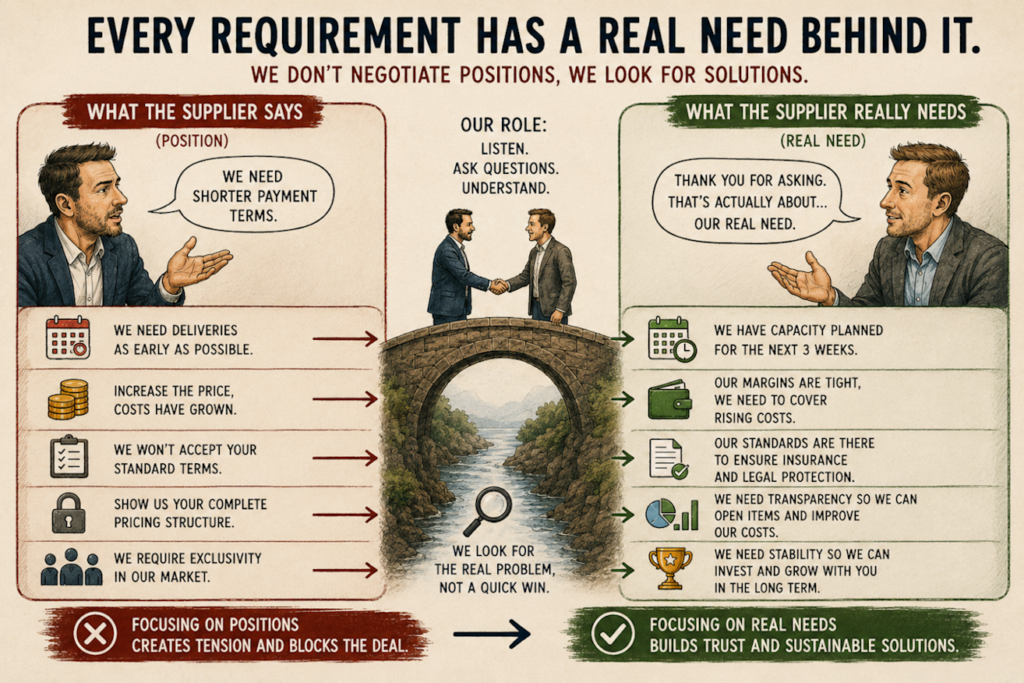
A Position Is Not a Need
The supplier is asking for shorter payment terms.
At first glance, the situation seems clear: they want to get paid sooner.
Procurement can reject the request, accept it, or propose a compromise. But that approach deals only with the visible position.
The far more important question is: why does the supplier need shorter payment terms?
Maybe they have a cash-flow problem. Maybe they need to pre-finance materials. Maybe their bank has tightened its terms. Maybe they are financing new capacity specifically because of our contract.
Once we understand the actual need, more options appear.
An advance payment. Milestone payments. Factoring. A longer contract. A volume commitment. A different schedule. An adjustment to inventory arrangements.
Good negotiation does not merely move numbers around.
It translates needs into tradable value.
And that is exactly where agreements emerge that simple haggling over a single condition could never create.
If You’re Always Talking, You Don’t Have Enough Information
Controlling a negotiation does not mean filling every second with your own voice.
In fact, the stronger negotiator is often the one who knows how to ask questions and listen to the answers.
Open-ended questions help uncover the other side’s motivations, constraints, and priorities.
What is the most difficult part of our proposal for you? How would the solution need to be structured for it to be acceptable? What is preventing you from meeting the required deadline? What impact would a change in volume have?
Then comes paraphrasing.
“Am I understanding correctly that the main problem is not the price, but uncertainty around volumes?”
A question like this does two things. It checks your understanding while also forcing the other side to confirm or clarify the real issue.
The more the other side talks, the more material we have to work with.
The more we talk, the more material they have.
There is no need to turn it into a detective story. Just remember from time to time that a negotiation is not a podcast and we do not have to fill the entire episode ourselves.
Watch the Reaction, Not Just the Answer
Negotiation does not happen only through words.
Tone of voice, speed of response, pauses, changes in posture, glances between team members, or the sudden need to look through some notes can all matter.
If we make an ambitious demand and the other side remains perfectly calm, that may be a warning sign.
Maybe they are an excellent negotiator.
Maybe we asked for too little.
Conversely, a dramatic reaction does not necessarily mean that we have crossed a line. It may simply be a prepared tactic. Some people can react to a number as though they have just discovered that you intend to repossess their family home.
A reaction is information.
It is not automatically the truth.
That is why it is important to read not just an individual signal, but the entire context.
A Concession Must Never Look Cheap
When we make a concession too quickly, the other side rarely thinks that we are being accommodating and generous.
They are more likely to wonder how much more room we still have.
Every concession should therefore have value—and ideally receive something of value in return.
We can accept longer payment terms if the price changes. We can adjust the deadline if we receive a capacity commitment. We can extend the contract if the indexation mechanism is revised.
A concession without an exchange is not negotiation.
It is a gift.
And procurement can, of course, give gifts. It just should not do so accidentally and without a bow.
Closing a Deal Requires Precision
The meeting is coming to an end, the atmosphere relaxes, and everyone feels that an agreement has been reached.
This is one of the most dangerous moments.
Each side may be leaving with a slightly different version of what was actually agreed.
That is why the conclusion must include a precise summary: what we agreed on, what remains open, who is responsible for what, and by when the next steps need to happen.
A vague nod is not enough.
We need to verify that the other side understands the proposal, agrees with it, and has the authority to deliver on it. Otherwise, two days later, an email may arrive beginning with:
“Following internal consultation, we have concluded that…”
That is corporate dialect for saying yesterday’s agreement was not actually an agreement.
It is good practice to summarise the points aloud before the meeting ends and then confirm them in writing.
Ideally before human memory starts creatively rewriting the past.
If an Agreement Isn’t Possible, Don’t Burn the Bridge
Sometimes the parties do not reach an agreement.
That is not automatically a failure.
What matters is how we end the negotiation.
Saying, “Under the current conditions and based on the information we have today, we are unable to reach an agreement,” leaves room for future movement.
Saying, “We will never accept this,” builds a wall.
The market, volume, timing, budget, or available alternatives may change. Absolute statements force people to defend old positions later simply because they do not want to appear inconsistent.
The door does not need to be wide open.
Just do not weld it shut.
After the Meeting Comes the Part Almost Everyone Skips
The negotiation ends. The team returns to emails, internal requests, and the three new crises that have emerged in the meantime.
No review takes place.
If we achieved our objective, we consider the meeting a success. If we did not, we say the supplier was inflexible.
But by doing this, we lose the most valuable part of the entire process.
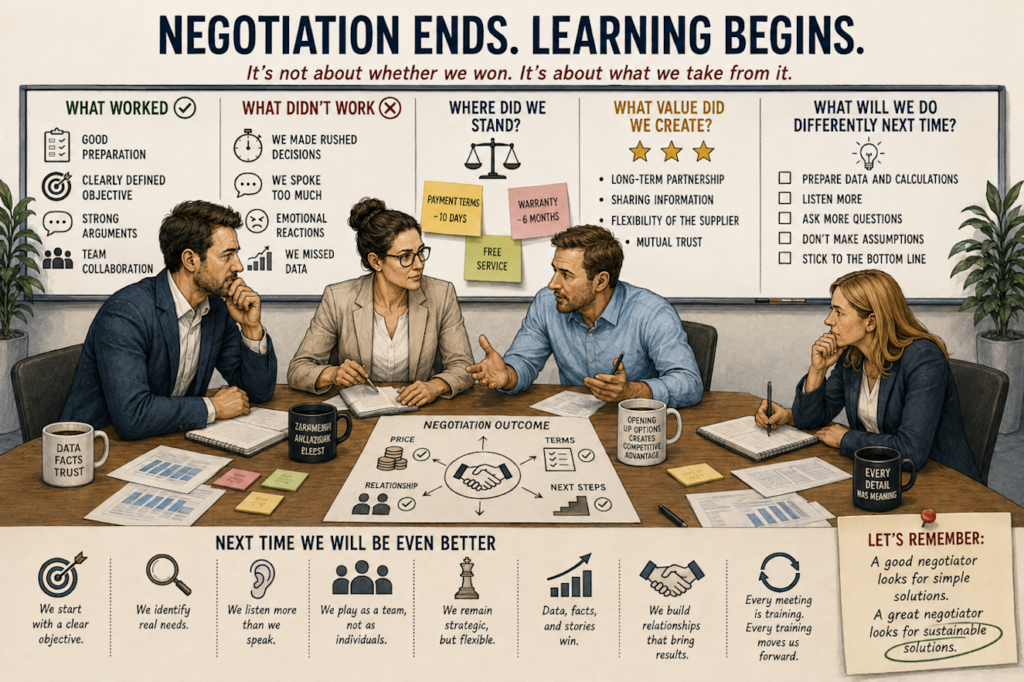
After every significant negotiation, we should ask ourselves a few questions.
What worked? What did not? When did the atmosphere change? Which question caused the other side to open up? Which demand triggered resistance? How well did the team stick to its roles? What did the lead negotiator miss? Where did we concede too quickly? And what will we do differently next time?
The outcome tells us where we ended up.
The review tells us why we ended up there.
Without it, we can repeat the same mistake for years and describe it as a unique situation every single time.
Talent Is Nice. Process Is More Reliable.
Some people have a natural instinct for communication. They react quickly, read emotions well, and project confidence.
That helps.
But on its own, it is not enough.
A good negotiator prepares. They know their objective, their boundaries, and their alternatives. They think through their strategy. They assign roles. They listen. They watch reactions. They summarise the agreement. And after the meeting, they go back and examine what actually happened.
It is not as dramatic as slamming your fist on the table and delivering a profound one-liner.
But it is considerably cheaper.
Negotiation is not a competition to see who can wear the toughest expression in the room. It is a discipline in which every lack of preparation comes at a cost.
Sometimes it is a percentage point on the price. Sometimes a contractual term. Sometimes a long-term relationship. And sometimes several years of the life of the colleague who will have to manage a contract created during a meeting conducted under the guiding principle of “we’ll figure something out.”
Because somehow, things always work out.
Just not always well.
Strongly inspired by the #Negotiation series, featuring #MartinPokorný and #MartinZelinka