News and inspiration from procurement and public procurement digitalization
When the Warning Light Is On and We Keep Our Foot on the Gas
Burnout rarely arrives with dramatic music playing in the background. It usually does not begin with a collapse, a resignation letter placed on the desk, or the words, “I can’t do this anymore.” It begins much more quietly.
You do not want to get up in the morning. In the evening, you cannot switch off. The weekend does not help. Your holiday ends and you feel as though you need another holiday afterwards — this time without people, without your phone, and ideally without your own thoughts.
And so you keep going.
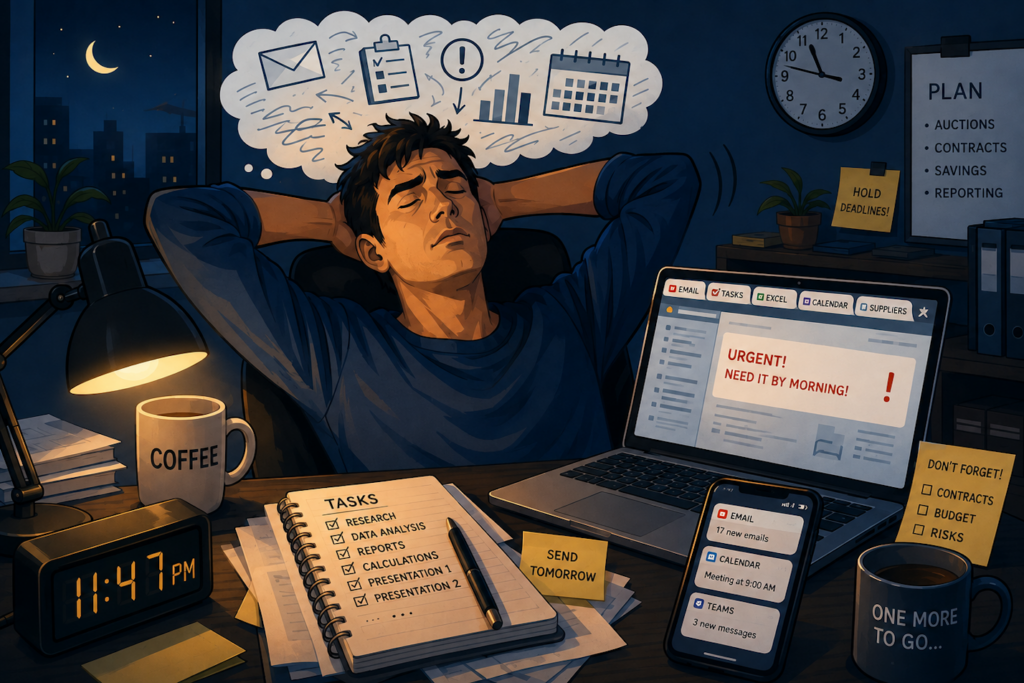
Because there is a deadline. Because a colleague is missing. Because you need to finish a tender, keep the budget under control, close a contract, call suppliers, prepare materials for management, and deal with another eight things that mysteriously became urgent overnight.
The warning light is on. The engine is making strange noises. But the calendar is full, so surely we cannot stop.
Burnout Is Not Just a Bad Week
Everyone gets tired sometimes. Everyone goes through periods when work is no fun, people get on their nerves, and an email with the subject line “quick question” makes them want to emigrate.
That alone does not necessarily mean burnout.
The difference is usually that ordinary tiredness fades after rest. You get some sleep, switch off, spend time with people who do not want a spreadsheet from you, and your energy starts to return.
With long-term exhaustion, however, something changes. A person rests but does not recover. They sleep but do not wake up refreshed. They go away, but their mind stays in the office, still working out who has not sent what, who will miss a deadline, and what will go wrong at 8:30 on Monday morning.
That is the warning moment.
Not that we are tired. But that the tiredness stops responding to the usual ways of recovering.
“I Want To, but I Just Can’t Anymore”
Burnout is often mistaken for laziness, lack of interest, or a loss of ambition.
But that is far too convenient an explanation.
A person experiencing burnout often does not want to work less because they no longer care about the result. Quite the opposite. Often, they care too much. They want to perform, they want to be reliable, and they do not want to let their team or management down. But the system has nothing left to draw on.
This is the crucial difference:
Not “I don’t want to.”
But “I would like to, I just simply can’t anymore.”
And this is often where another round of pressure begins. A person notices that they are no longer performing at the same level and, instead of stopping, they push harder. They start working longer hours, checking more, delegating less, and trying to make up for missing energy with sheer willpower.
Which is about as smart as dealing with an empty fuel tank by pressing the accelerator harder.
When the Exception Becomes the Normal Way of Working
Overload does not have to arise dramatically. It often begins as a temporary situation.
Someone leaves. A reorganisation takes place. A project is delayed. The workload is divided among people who already had enough work before. Everyone tells themselves it is only for a while.
But “for a while” has a strange ability to survive several quarters in the workplace.
Suddenly, a person is leading a team, handling operations, being held responsible for results, and reopening the laptop at home in the evening because there was no time during the day for the actual work. Twelve-hour days start to look normal. Fifteen hours is no longer an exception, just a worse-than-usual Tuesday.
And because performance is somehow still holding up, the people around them may not notice anything.
That is what makes burnout so deceptive. For a long time, it can look like admirable performance.
The person functions. Delivers. Responds. Copes.
They are simply paying an increasingly high price for it.
The Body Tends to Be Less Diplomatic Than Management
The mind can negotiate for a long time.
Just this month. Just this project. Just this closing period. Just this meeting. Just this tender. We will finish this, and then I will rest.
The body tends to communicate much more directly.
Insomnia. Tension. Headaches. Fatigue. Fevers. Heart palpitations. Poorer concentration. Irritability. The feeling that the brain keeps running even when it should have switched off long ago.
Suddenly, a bath, a weekend, or eight hours in bed does not help, because your mind is working the night shift.
And sometimes a strange but very revealing moment arrives: illness gives a person an alibi.
At last, they are allowed to rest.
Not because they planned the rest. But because they no longer have any other choice.
That is a rather sad approval process for taking time off.
Work as an Exchange of Life Time
At a certain stage, another question appears alongside the fatigue:
Why am I actually doing what I do?
This is not a whim or a motivational crisis after a bad Monday. It is a crack between effort and meaning.
Work is an exchange of life time for money. That sounds harsh, but it is accurate. And the moment a person stops understanding the meaning of what they are exchanging their time for, the deal starts to become painfully expensive.
The salary keeps arriving. Tasks keep getting completed. Performance may still look good.
But the person gradually stops being truly present.
They go to work, respond professionally, lead meetings, make decisions, but internally they are disconnected. The competence remains. The energy and the relationship to what they do do not.
It looks functional.
And that is exactly why it is so easy to overlook.
Perfectionism: A Suit That Looks Great but Is Hard to Breathe In
Burnout is not always just the result of a bad environment or an overloaded organisation.
Sometimes a person carries part of the pressure with them.
Perfectionism, the need to keep everything under control, difficulty delegating, a sense of responsibility for every mistake, and an inner belief that rest has to be earned.
These are very powerful engines.
Unfortunately, they do not know how to brake on their own.
A perfectionist often does not wait for someone else to demand the maximum. They create that demand themselves. They add another check, another review, another evening spent on a task that was already good enough two hours ago.
And when something goes wrong, they do not say to themselves: the system is overloaded.
They say: I should have handled it better.
By this I do not mean that people “cause their own” burnout. That would be simplistic and unfair. Working conditions, organisational culture, leadership, workload, and long-term stress all play an enormous role.
But without recognising their own patterns, a person can change company, position, and boss — and after some time build exactly the same problem again in a new environment.
New office. Old routine.
Procurement Can Turn People into Firefighters
Procurement and public procurement contain several very practical ingredients for exhaustion.
Deadlines that cannot be moved. Internal customers who know exactly what they want — especially two days before the deadline. Suppliers who send a document one minute before the submission period ends. Outages, complaints, budgets, audits, changes to specifications, and responsibility for things procurement often cannot fully influence.
Add pressure for savings, speed, transparency, zero mistakes, and ideally some innovation as well.
The result is a peculiar profession in which people expect the unexpected, plan the unplannable, and regard three crises landing in the same week as normal.
In the short term, it can be managed.
In the long term, however, resilience can turn into a habit of ignoring your own limits.
And that is not resilience.
It is simply a well-organised way of overlooking the problem.
Burnout Does Not Politely Stay at the Office
Work that drains a person over the long term usually respects working hours about as much as some meetings respect the schedule.
It does not stay at the office.
It follows you home, into relationships, weekends, sleep, and your ability to feel ordinary joy.
A person is physically present but mentally still dealing with work. Their partner is talking, the children need something, friends are planning a trip — and meanwhile their mind is recalculating capacity, deadlines, or a problem with a supplier.
Gradually, the sense of ease disappears.
And the people around them often notice it before they do.
But change cannot be forced. A partner, colleague, or manager can point things out, ask questions, and offer help. They cannot make the decision on someone else’s behalf that things cannot continue this way.
The person has to admit that to themselves.
And sometimes that is the hardest part.
Delegation Is Not a Loss of Control
One important turning point can be changing the way people are managed.
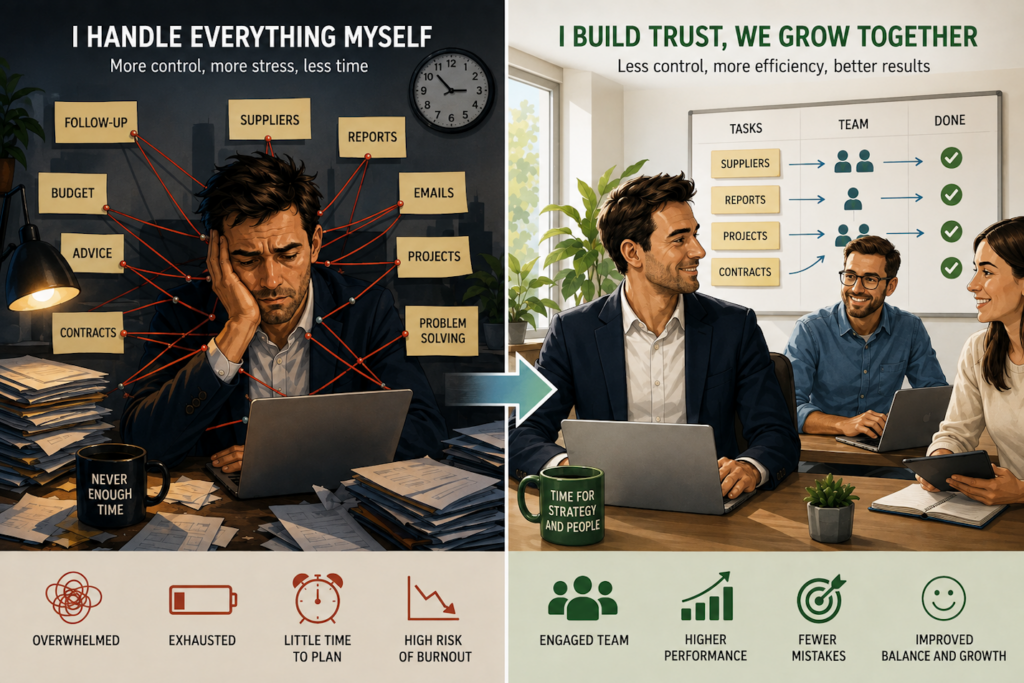
Less control. More trust. Real delegation, not the version that says, “do it your way, but exactly the way I would do it.”
When a person stops holding on to every decision, every piece of information, and every minor task, catastrophe often does not follow.
Quite the opposite.
The team starts taking on more responsibility. People become more involved. The atmosphere relaxes. And the manager gradually discovers that their presence is not required for every comma, approval, and email.
For a perfectionist, that can be almost unsettling.
The whole thing works even without them.
But that is a sign of a healthy team, not professional failure.
A good manager is not someone without whom everything stops.
That is not a leader. That is a human bottleneck in the process.
Changing Jobs May Not Be Enough
When a person is exhausted, leaving often looks like the obvious solution.
And sometimes it really is.
But changing the environment alone may not change the way a person works, takes responsibility, and manages their own energy.
They may leave an overloaded role for a calmer job and discover that they miss the pace, responsibility, or sense of purpose. Then another management position comes along, a new beginning, and the old habits quietly return.
The same level of control. The same need to prove performance. The same difficulty saying no.
That is why real change has two parts.
External: working conditions, workload, resources, role, leadership.
Internal: boundaries, expectations, perfectionism, the need for control, and your own definition of success.
Without one or the other, the problem can easily return in new packaging.
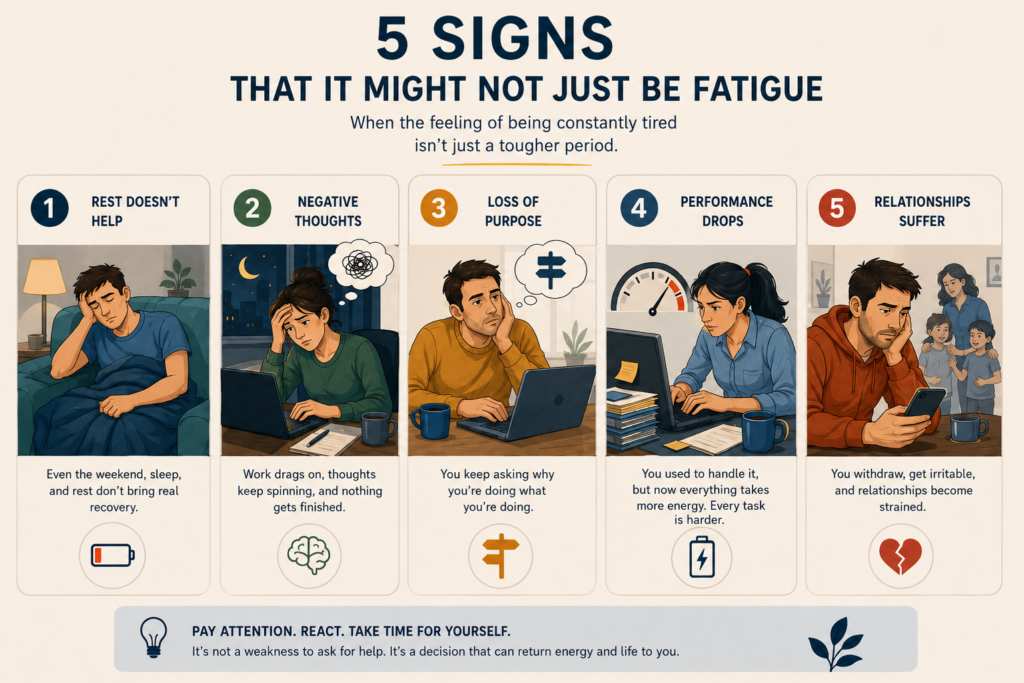
Five Signs That It May Be More Than Just Tiredness
Rest does not help. A weekend, sleep, or a holiday does not bring genuine recovery.
Your mind cannot switch off. Work continues in your thoughts long after the working day has ended.
You are losing your sense of purpose. It is no longer only about having too much work. You are beginning to lose sight of why you do it at all.
You are maintaining performance through sheer force. You keep functioning, but it costs you more and more energy, and every additional task feels harder.
Work is pushing out the rest of your life. Relationships, rest, interests, and the ability to be truly present outside work begin to disappear.
One sign on its own does not necessarily prove anything. A long-term combination of several signs deserves attention.
And if the condition persists, gets worse, or significantly affects health and day-to-day functioning, there is no shame in turning to a doctor, psychologist, or psychotherapist.
The greater mistake is pretending that the warning light is not on because we have an important meeting.
Stopping Is Not the Same as Giving Up
Burnout is not proof of weakness.
It often affects precisely those people who are responsible, high-performing, reliable, and capable of handling more than others for a long time. But the ability to tolerate overload for a long time does not mean that overload is healthy.
The real turning point comes when a person stops seeing rest as a reward for completed work.
Because work will never be completely finished.
There will always be another deadline, another request, another tender, another supplier, another spreadsheet, and another person who needs an answer “ideally today.”
Anyone waiting until everything is finished before allowing themselves to rest is waiting for an event rather like a total solar eclipse. It exists in theory. In practice, you cannot plan an ordinary week around it.
Sometimes you need to slow down. Delegate. Say no. Reconsider your role. Change your environment. Seek help. Or admit that work which once felt meaningful no longer does.
That is not defeat.
Defeat is ignoring all the signals for so long that the body makes the decision for us.
The warning light is not the enemy. It is the last polite warning before the whole system decides to stop cooperating.
And at that point, not even an Excel spreadsheet with an action plan will help.
Jan Jedlička
An agile observer of the future of information systems and trends in procurement, passionately transferring the magic of collective know-how through practical tips and tricks. He sees his mission in overcoming the fear barrier when implementing innovations and electronic tools in procurement processes both in the private and public sectors. He enjoys imagining a vision of success and then overseeing its realization. Currently, he works as a consultant for the digitalization and improvement of internal processes at PROEBIZ and is involved in the development of the eProcurement.TV project.
There are several moments in a negotiation when the atmosphere in the room changes. Someone states a number. The other side goes quiet. One participant leans back, another…
In some companies, commodity strategy has a reputation for being a document that gets created once a year, goes through a round of comments, gets a logo and…
Negotiations often go wrong before the participants even sit down at the table. Not because of a bad offer. Not because of an aggressive supplier. And usually not…
PROEBIZ is a team of specialists, know-how and a suite of software applications specialising in the digitalisation of both corporate and public procurement.
To provide the best experiences, we use technologies like cookies to store and/or access device information. Consenting to these technologies will allow us to process data such as browsing behavior or unique IDs on this site. Not consenting or withdrawing consent, may adversely affect certain features and functions.
Functional
Always active
The technical storage or access is strictly necessary for the legitimate purpose of enabling the use of a specific service explicitly requested by the subscriber or user, or for the sole purpose of carrying out the transmission of a communication over an electronic communications network.
Preferences
The technical storage or access is necessary for the legitimate purpose of storing preferences that are not requested by the subscriber or user.
Statistics
The technical storage or access that is used exclusively for statistical purposes.The technical storage or access that is used exclusively for anonymous statistical purposes. Without a subpoena, voluntary compliance on the part of your Internet Service Provider, or additional records from a third party, information stored or retrieved for this purpose alone cannot usually be used to identify you.
Marketing
The technical storage or access is required to create user profiles to send advertising, or to track the user on a website or across several websites for similar marketing purposes.