We often imagine negotiation as a scene from a movie. Two parties sit across from each other, a glass of water on the table, someone slowly takes off their glasses and says: "So, let's talk about the price."
But by that point, half of the outcome has usually already been decided.
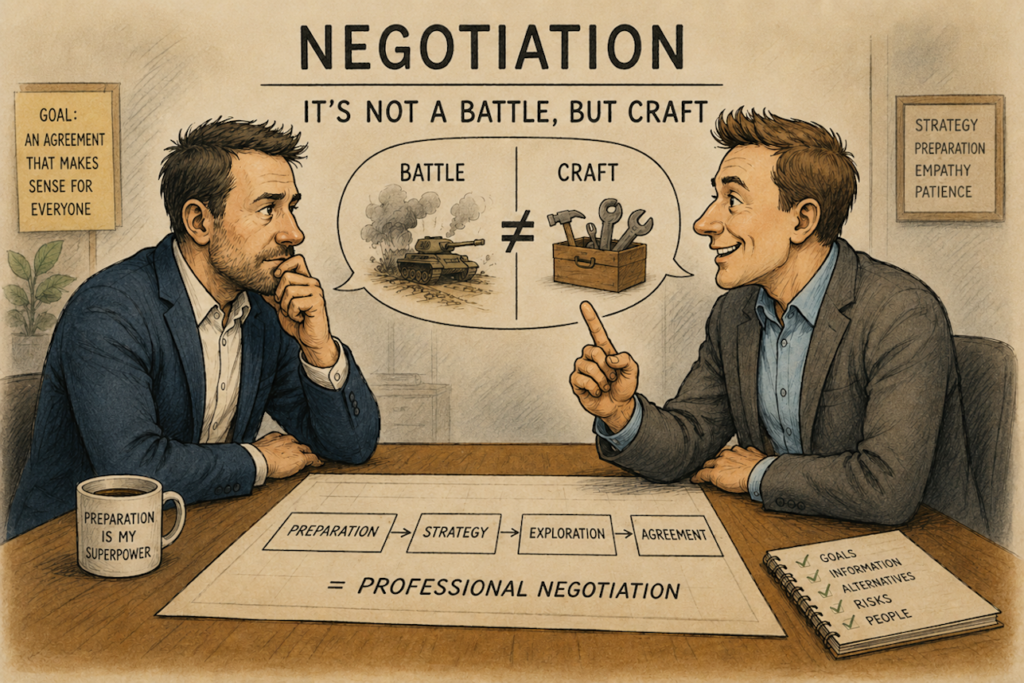
Negotiation doesn't begin with the first argument. It begins much earlier—the moment we define what we truly want, what the other party wants, where our interests collide, and what we are willing to do if no agreement is reached.
And above all: negotiation doesn't begin where everyone agrees. It begins where conflict arises.
When Everyone Agrees, You're Not Negotiating
The supplier offers a price of one hundred. The buyer says they agree. Both parties sign the contract and walk away satisfied.
That is not negotiation. That is a transaction.
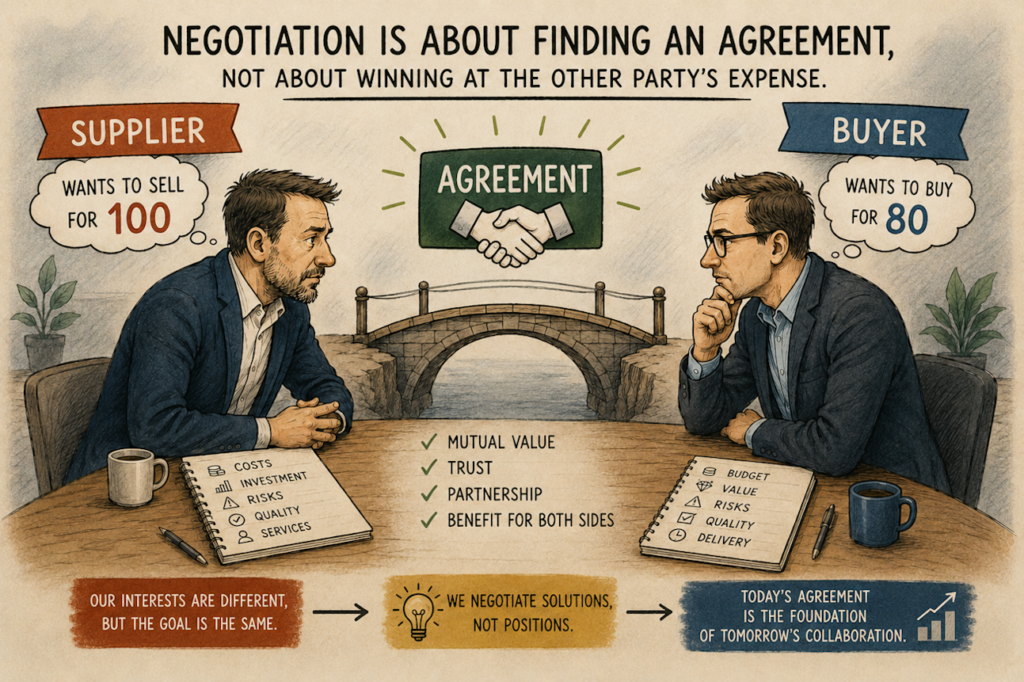
Negotiation begins when the supplier wants one hundred and the buyer is willing to pay eighty.
One party wants a longer contract, the other wants greater flexibility. One needs faster payment, while the other operates under internal payment terms that still remember the days of fax machines and smoking in the office.
This is where the real work begins.
Conflict is not a flaw in the process. It is not proof that the negotiation has gone wrong. Conflict is a natural consequence of each party entering the relationship with different priorities, costs, risks, and responsibilities.
The problem is not that interests diverge.
The problem begins when both sides pretend the conflict doesn't exist—or start trying to resolve it through force.
Without a Shared Interest, There's Nothing to Negotiate
For negotiation to exist at all, disagreement alone is not enough. There also has to be a shared objective.
The supplier wants to sell. The customer wants to buy. The contracting authority needs a service. The supplier wants the contract. Both parties need each other, although each in a slightly different way—and neither would like to admit it too loudly.
It is precisely this mutual dependence that creates room for agreement.
When one party doesn't need the other at all, it is no longer negotiation. It is simply announcing the terms. Or a breakup. Sometimes both in the same email.
In procurement, it is essential to understand how strong this dependency really is. Do we have alternative suppliers? Does the supplier have other customers? Are we an important client? Is the commodity easy to replace? How much time do we have? And which of us will face the bigger problem if no agreement is reached?
These are not academic questions. They are the basic map of your negotiating position.
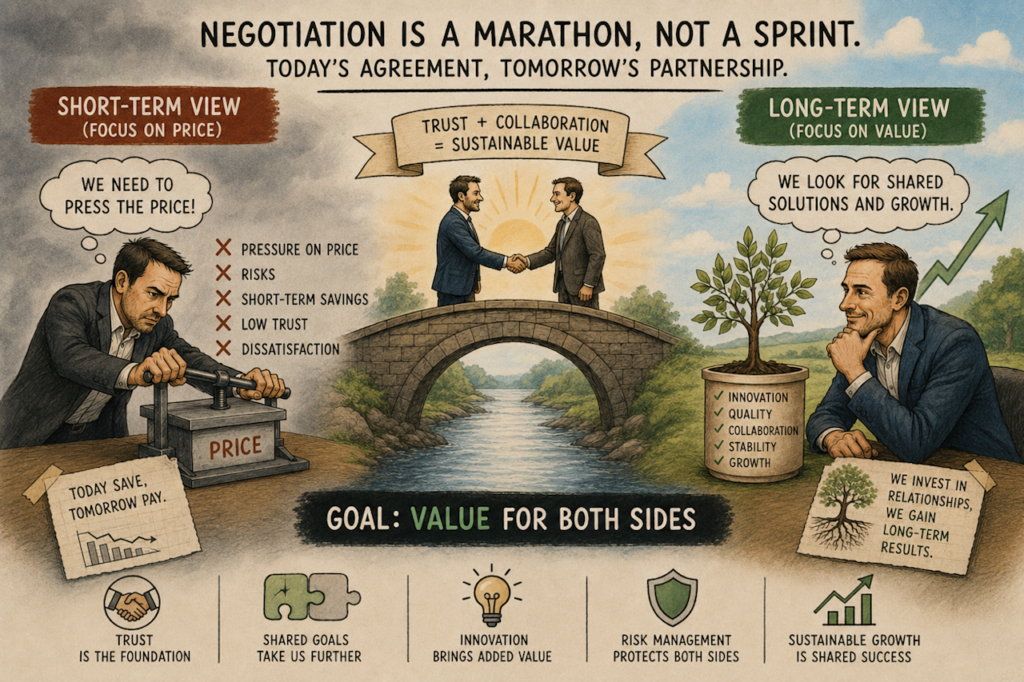
Decide First: The Outcome or the Relationship?
One of the most important questions comes even before the negotiation itself:
Do we want to maximize the immediate outcome, or protect the long-term relationship?
Both are legitimate objectives. But the negotiation strategy must change accordingly.
For a one-off purchase of a standardized item, price and speed may play the biggest role. With a strategic supplier on whom production, operations, or a critical service depends, the approach of "squeeze them dry and walk away" starts to resemble running a business with nothing but a hammer.
Yes, a hammer is effective. Just not for everything.
If the goal is a long-term partnership, we cannot treat every negotiation as the decisive battle over the last dollar. We may gain something in the short term. But in the long run, we may create a supplier who fulfills the contract precisely, rigorously, and without doing a single thing beyond what is strictly required.
Which is a rather quiet form of supplier revenge.
Good negotiation, therefore, does not always mean pushing harder. Sometimes it means giving way on a point that isn't crucial to us in order to gain something far more important. Sometimes it means giving the supplier room to breathe because their stability is in our own best interest.
And sometimes it means saying no.
Not theatrically. Not out of offense. Simply because a bad deal is still a bad deal—even if six directors sign it ceremoniously and pose for a photo on LinkedIn.
Emotions Act Before Spreadsheets Do
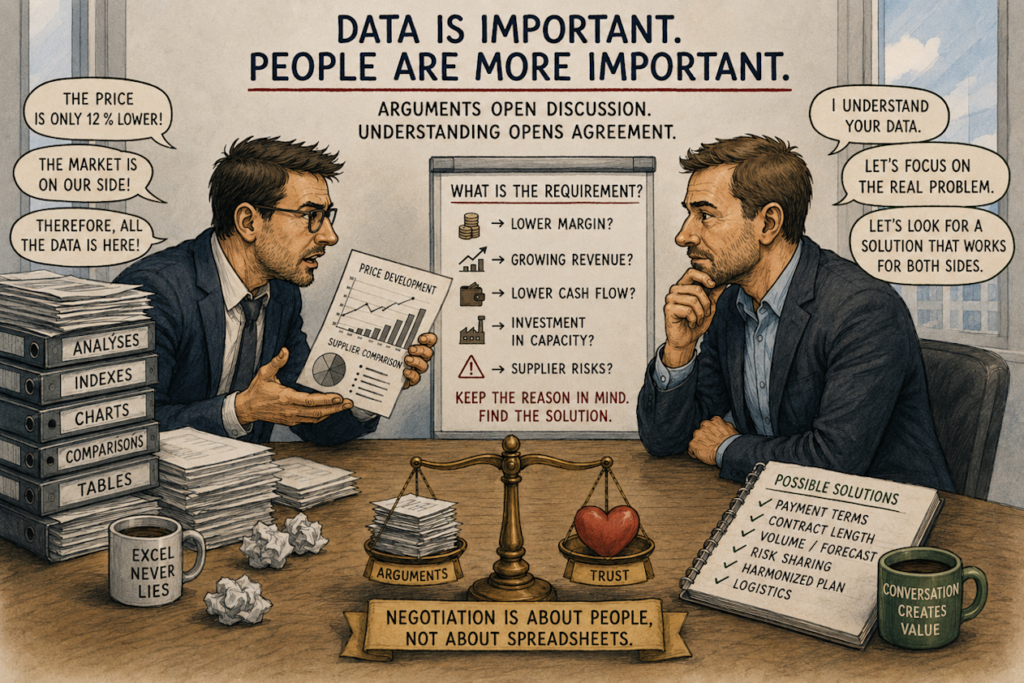
Procurement loves numbers. Price, Savings, Volume, Indexation, Payment terms, Total cost. Numbers feel safe. They don't get offended, they don't raise their voices, and they usually don't walk out of meetings.
But negotiations are conducted by people.
And people react emotionally first.
Only afterwards do they rationally explain their reaction.
If we push the other party into a corner, publicly question their competence, or make them feel that we are trying to humiliate them, they will become defensive. At that point, they are no longer focused on the terms of the agreement. They are focused on protecting their own position.
And that can become expensive.
A positive atmosphere does not mean we should smile at everyone, hand out cookies, and accept the first offer. It means creating an environment where people can speak openly without feeling unnecessarily threatened.
Respect is not softness. Calmness is not weakness. And courtesy is certainly not negotiation surrender. Quite the opposite.
Someone who truly has the situation under control does not need to prove their strength every other sentence.
Arguments Are Useful—Until They Become a Tug-of-War
Preparation for negotiation often looks like this: the team prepares twenty arguments, fifteen spreadsheets, and a presentation that would require a small forest to print.
Then they walk into the meeting and start proving that they are right.
The other side does exactly the same.
And suddenly we have all the ingredients for a very professional-looking argument.
Arguments have their place. They help explain the situation, support a request, or demonstrate the economic impact. But by themselves, they do not resolve conflict. When each side digs into its own version of the truth, more data often does nothing except strengthen the trenches.
The supplier presents evidence of rising input costs. The buyer shows declining market prices. The supplier brings one index. The buyer brings another. In the end, everyone agrees on only one thing—that Excel can create a graph out of almost anything.
A better question is therefore not: How can we prove that we are right?
A better question is: Why is the other party asking for this?
Behind a request for a higher price may be low margins, expensive financing, limited production capacity, or simply an attempt to create room for concessions. Behind a request for a longer contract may be the need to plan production. Behind the rejection of contractual penalties may be previous experience with unclear specifications.
A position is what the other party says. An interest is why they say it.
Negotiation only starts moving forward once we get beneath the surface.
Compromise: An Elegant Way to Frustrate Everyone
Compromise has an excellent reputation. It sounds reasonable, diplomatic, and mature.
But not every compromise is a good agreement.
When one party wants one hundred and the other wants eighty, ninety may seem like a fair outcome. But it may not be. The supplier may fall below profitability, while the buyer exceeds their budget. Both sides have made concessions, nobody is satisfied, and the problem has simply been postponed in a neat package.
A truly good agreement does not necessarily lie in the middle.
Perhaps the volume changes. The contract duration. The payment terms. The scope of the service. The delivery schedule. The allocation of risk. Indexation. The ordering process. Minimum purchase commitments. Logistics.
This is where the difference between bargaining and negotiating becomes obvious.
Bargaining revolves around a single number.
Negotiation seeks value across the entire structure of the agreement.
This is important in both corporate procurement and public procurement, with one significant difference: in the public sector, the room for negotiation is always determined by the chosen procedure, the applicable rules, and the conditions established in advance. Creativity is a wonderful thing—but an audit trail usually has a much longer memory than the people who attended the meeting.
Ego Is One of the Most Expensive Items in the Shopping Basket
In negotiation, it is surprisingly easy for the original objective to disappear and be replaced by the need to win.
Suddenly, it is no longer about price, delivery dates, or quality. It becomes about who gives in first. Who was right. Who apologizes. Who looks stronger in front of their own team.
Ego can turn a perfectly reasonable negotiation into an expensive exercise.
The buyer rejects a perfectly workable proposal simply because it wasn't their idea. The supplier insists on a condition that is not actually critical because they have already declared it non-negotiable. The manager escalates the dispute because they don't want to appear weak in front of colleagues.
Everyone stands firmly on principle. The outcome is a disaster. But at least it is a principled disaster.
That is why a professional negotiator must constantly keep one simple question in mind: What is the objective?
Not who won the discussion. Not who had the last word. Not who looked the toughest.
What did we actually need to achieve?
Sometimes the best outcome is also the least dramatic one. There is no emotional scene. Nobody slams the door. Nobody delivers a line worthy of a movie trailer. The risks are simply reduced, operations continue, and both sides reach an agreement they can live with.
In procurement, that is a surprisingly valuable achievement.
In Public Procurement, Negotiation Is Not Based on Gut Feeling
In corporate procurement, the room for negotiation is often much broader. The parties can explore different options, reshape the commercial structure, and search for various combinations of terms and conditions.
In public procurement, however, it is essential to understand much more precisely under which legal framework the contracting authority is operating and what the chosen procedure actually allows.
This does not mean that a public contracting authority cannot apply negotiation principles.
It can—and it should.
But it must clearly understand where it is operating within the boundaries of legitimate negotiation and where it would begin to alter the rules of the game that has already been set in motion.
Thorough preparation, understanding suppliers' interests, carefully designing the procurement conditions, working with the market, and communicating clearly are always essential.
Improvisation along the lines of "Let's put some pressure on them and see what happens" is considerably less so.
After all, the phrase "We all knew what was meant" works perfectly—right up until you have to explain it to someone who wasn't in the room.
The Strongest Negotiator Doesn't Have to Be the Loudest
Good negotiation is not built on aggression. Nor is it built on rehearsed tricks or the ability to overwhelm the room with arguments.
It is built on understanding conflict.
On having a clear objective. On knowing your own position. On distinguishing positions from genuine interests. On managing emotions. On maintaining the discipline to keep ego from taking control of the meeting.
And also on being willing to accept that reaching an agreement is not always the best possible outcome.
The best negotiators do not necessarily look like people who have just won a war. More often, they look like someone who knew exactly where they wanted to go from the very beginning—and never allowed themselves to be drawn into three unnecessary battles, two personal disputes, and one presentation on the price development of aluminum since 1987.
Because the purpose of negotiation is not to defeat the other party.
The purpose is to obtain what truly matters while, ideally, avoiding scorched earth, a frustrated supplier, and colleagues who would rather not invite you to the next meeting.
That is no longer toughness. That is simply an expensive mess dressed in a business suit.
Strongly inspired by the #Negotiation podcast featuring #MartinPokorný and #MartinZelinka.