News and inspiration from procurement and public procurement digitalization
Commodity Strategy Isn’t Theory. It’s How Procurement Stops Just Putting Out Fires
In some companies, commodity strategy has a reputation for being a document that gets created once a year, goes through a round of comments, gets a logo and a date, and is then filed away somewhere it will never bother anyone again.
Formally complete. Practically useless.
But a real commodity strategy isn’t a presentation for management or a methodological exercise. It’s a working tool that helps procurement understand a category, set priorities, anticipate risks, and make decisions before things start burning.
And that is precisely where its greatest value lies.
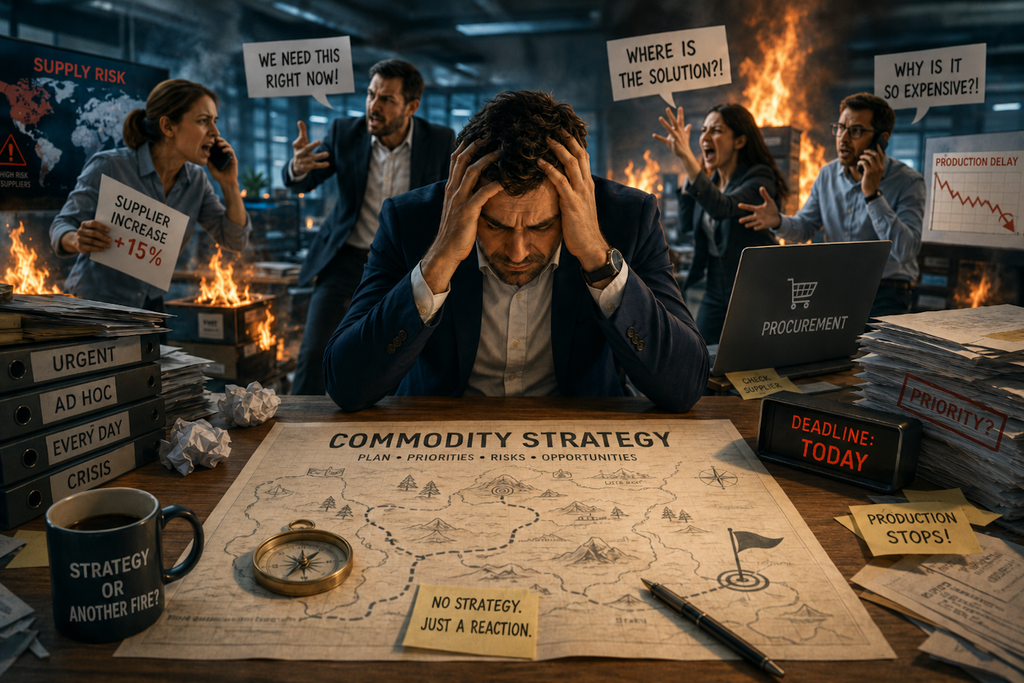
Without a strategy, procurement often just reacts. A supplier announces a price increase, someone changes a requirement, production discovers that a critical item is running out, a contract expires in three weeks, and the internal customer asks in surprise why procurement hasn’t done anything about it.
Which, incidentally, is a favorite corporate discipline: a problem develops for six months, but procurement is expected to solve it by Friday.
Strategy Doesn’t Start in Procurement
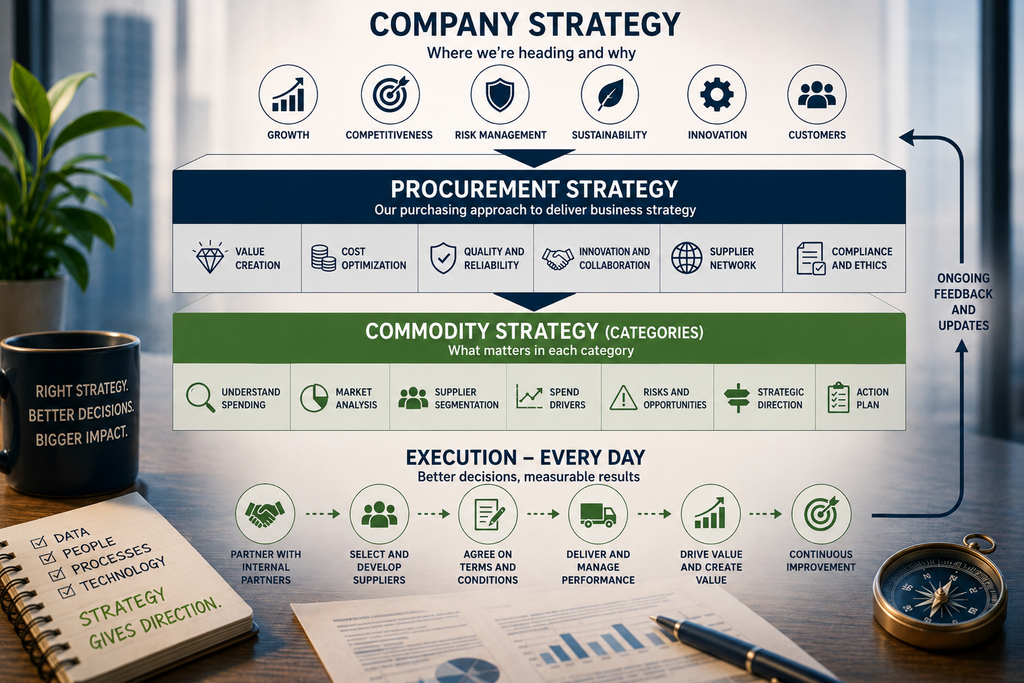
A commodity strategy cannot exist in isolation. It has to be aligned with where the entire organization is heading.
❓ Is the company planning to grow?
❓ Enter a new market?
❓ Change its product portfolio?
❓ Reduce costs?
❓ Stabilize the supply chain?
❓ Put greater emphasis on sustainability?
❓ Relocate production?
❓ Digitalize?
Every one of these moves changes what procurement needs to do.
If the company is expanding, capacity availability may become critical. If it wants to reduce risk, supplier diversification will matter more. If innovation is the priority, price alone will no longer be enough, and a supplier’s ability to bring new solutions to the table will carry more weight.
So commodity strategy does not start with the question:
“How are we going to buy this category?”
It starts with:
“What will the company need in the coming years, and what role will this category play in that?”
Only then does it make sense to address suppliers, contracts, the market, cost drivers, and specific actions.
Otherwise, procurement is creating strategy in a vacuum. And strategy created in a vacuum tends to be elegant, well structured, and practically useless.
Not Every Category Needs the Same Level of Attention
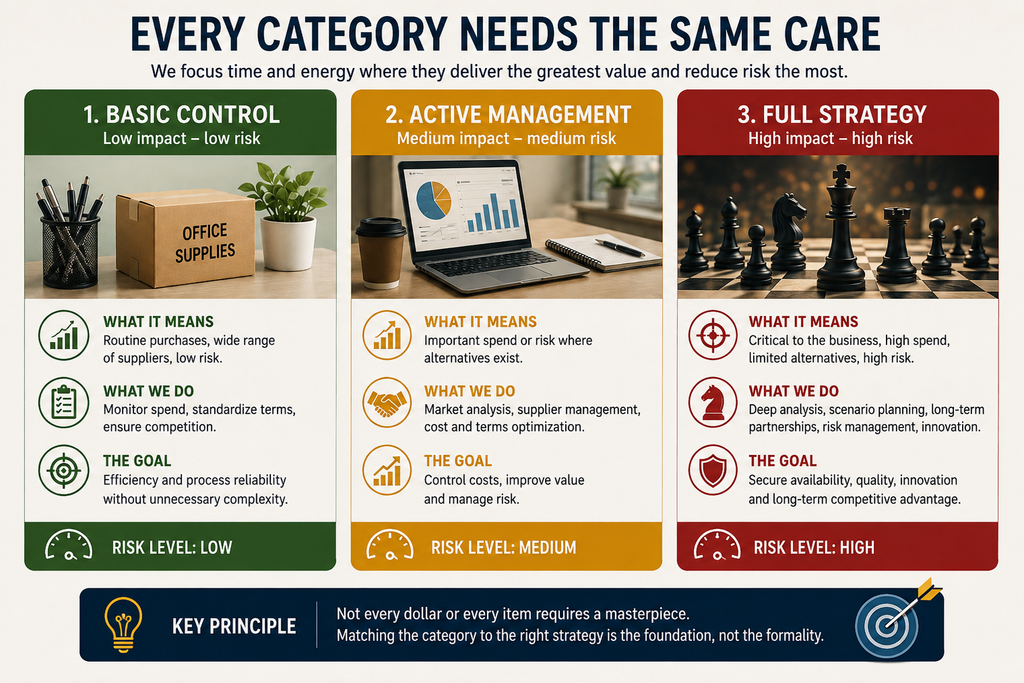
One of the most common mistakes is assuming that every category needs an equally comprehensive strategy.
It doesn’t.
A procurement team has limited time, limited capacity, and usually limited patience from internal stakeholders as well. If it devotes the same level of effort to office supplies, production technologies, energy, and critical components, it isn’t doing strategy. It’s simply distributing a shortage of time equally.
So the first task isn’t to write a document.
The first task is to decide where strategic work actually makes sense.
Some categories only need basic control, contract visibility, and regular market monitoring. Others deserve active supplier management, risk management, a long-term plan, and close cooperation with internal customers.
And spend alone should not determine the decision.
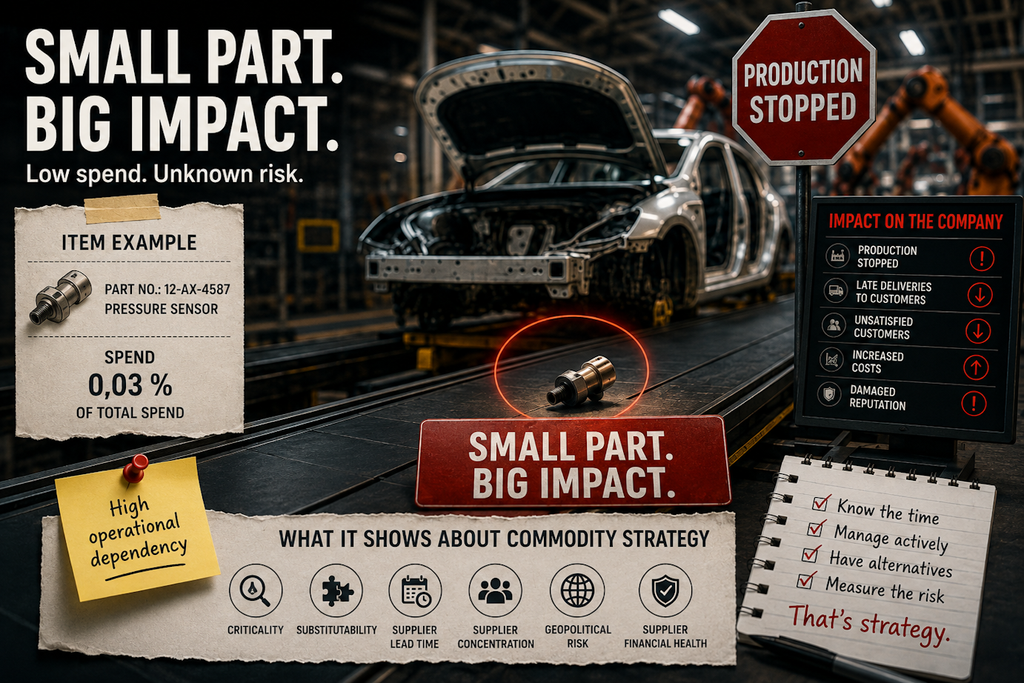
An item may represent a tiny share of total expenditure, yet its unavailability could stop production. Another category may have high spend but also a stable market, plenty of alternatives, and low operational risk.
If you only look at the amount of money involved, you may overlook exactly what will hurt the company most one day.
Small Item, Big Problem
Imagine a component that represents a negligible share of the final product’s cost.
It doesn’t look important in a report. In a spend analysis, it is buried somewhere deep below the major categories. Management may never even have heard of it.
Then it becomes unavailable.
Production stops. Deadlines slip. Sales explains the delays to customers. Finance starts calculating the damage, and suddenly everyone knows the name of the item nobody cared about yesterday.
That is exactly why commodity strategy isn’t only about price and volume.
It also has to consider criticality, substitutability, lead times, market concentration, geographical risks, suppliers’ financial stability, and dependency on a particular solution.
Strategy helps you see the problem before a small item turns into a big meeting.
Common Sense Wrapped in Methodology
Commodity strategy can sometimes seem unnecessarily complicated. Frameworks, matrices, analyses, market maps, scenarios, and action plans can create the impression that buyers aren’t even allowed to look at a supplier without a proper methodology in place.
In reality, it is often simply common sense wrapped in a repeatable process.
❓ What are we buying?
❓ Why are we buying it?
❓ Who needs it?
❓ How will demand evolve?
❓ Who can supply it?
❓ How does the market work?
❓ What drives the price?
❓ What risks are we carrying?
❓ What alternatives do we have?
❓ What do we want to change over the coming months and years?
Methodology helps ensure the team doesn’t forget the important questions. But methodology alone will never create a strategy.
We can fill in every table, prepare a beautiful matrix, and create a forty-page presentation. But if we don’t understand our own demand, the supplier market, and the business context, all we have is a more expensive version of an assumption.
A Category Is Not a Name in an ERP System
One company buys cars.
Another manages a vehicle fleet.
A third manages employee mobility.
At first glance, they may appear to be the same category. In reality, they lead to three very different strategies.
With cars, the main issues may be purchase price, servicing, and residual value. Fleet management adds operations, administration, financing, insurance, and lifecycle management. Mobility may involve a combination of cars, public transport, shared services, and employee policies.
Defining the category correctly therefore has a fundamental impact on everything that follows.
A definition that is too narrow leads to isolated decisions. One that is too broad creates a monster nobody understands and nobody can realistically manage.
There is no single universal category structure that works for every company.
Categories need to reflect how the organization operates, what it buys, and how it wants to manage the market.
We are not robots. And category management is not a cataloguing competition.
Without Data, Strategy Is Based on Gut Feeling
A good commodity strategy is built on data. Not because data makes it look professional, but because data makes it possible to make decisions.
We need to understand expenditure, volumes, suppliers, contracts, pricing conditions, consumption trends, internal requirements, complaints, supplier performance, and future projects.
And this is often where the problems begin.
Data sits in several different systems. Contracts are scattered across different folders. Items have inconsistent names. One supplier appears under three different IDs, and some purchasing happens outside contracts because “we’ve always done it this way.”
Strategy then emerges from a combination of reports, experience, estimates, and a little collective optimism.
That isn’t necessarily always a bad thing. Perfect data does not exist, and waiting for it would mean never getting started. But we do need to know where we are working with facts and where we are working with assumptions.
Otherwise, an assumption quickly disguises itself as a strategic decision.
And the presentation gives it a chart for good measure.
Understanding Your Own Spend Isn’t Enough
Spend analysis tells us who we pay, how much we pay, and approximately what we pay for.
That is an important starting point.
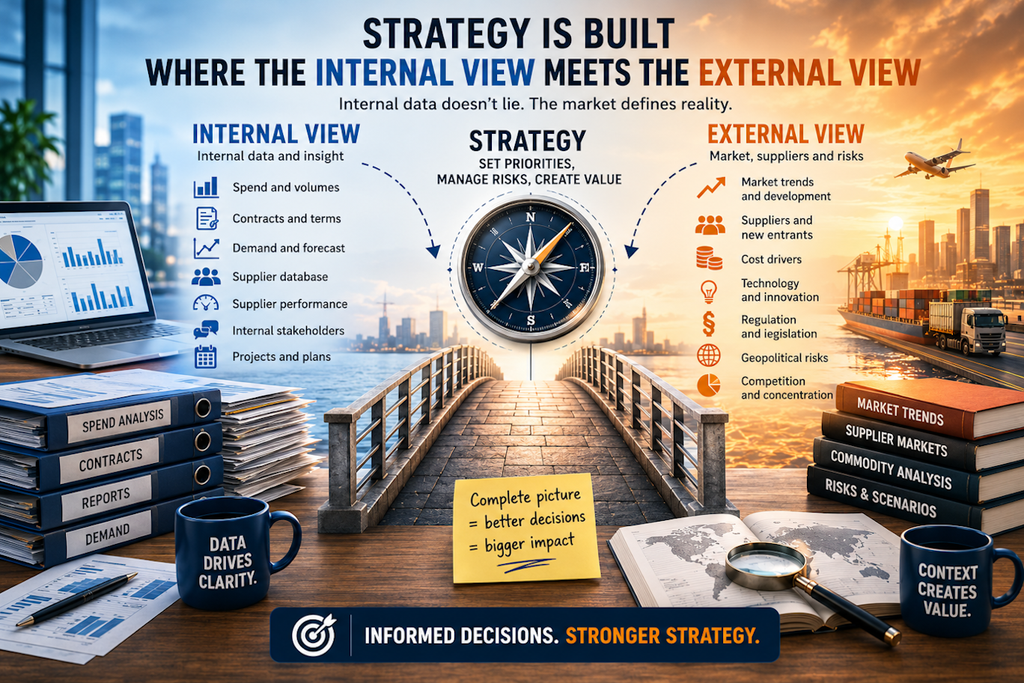
But commodity strategy also requires an external perspective.
How is the market changing? Are new suppliers entering, or is the market consolidating? Which inputs influence price? What technologies are emerging? What regulations could reshape the category? Where are capacity constraints developing? How strong is our position relative to suppliers?
Procurement that only knows its own data sees only half the picture.
It may know exactly how much it bought last year but have no idea why the price is changing this year. It may know its list of suppliers but not realize that two of them have the same owner or depend on the same critical source.
✔ Internal data shows what we have done.
✔ The market shows what lies ahead.
✔ Strategy has to connect the two.
The Internal Customer Is Not an Obstacle to Strategy
Commodity strategy is not created by procurement alone.
The internal stakeholder understands the need, operational reality, technical requirements, and future projects. Procurement understands the market, suppliers, contractual options, cost implications, and risks.
Only by combining these perspectives can you create a strategy that actually works.
Problems arise when each side starts defending its own territory.
The technical team says procurement doesn’t understand the specification. Procurement argues that the technical team doesn’t understand the market. Finance wants savings. Operations wants certainty. Management wants everything — preferably in a presentation by next Tuesday.
The result is often a compromise that nobody truly owns.
A strong strategy therefore requires clear agreement on several points:
❓ What does the company actually need?
❓ Which requirements are genuinely essential, and which are simply historical?
❓ What risks are we willing to accept?
❓ What do we want to get from suppliers?
❓ Where is there room for standardization or demand change?
Procurement should not simply be the ordering department. It should be a partner that helps shape demand.
If procurement only enters the process once the solution has been fully designed, the supplier selected, and the deadline set, it isn’t creating strategy.
It is merely administering someone else’s decision.
A Living Document, Not a Corporate Fossil
Commodity strategy should be a living working document.
That doesn’t mean the team has to rewrite it every week. It means the strategy is actually used to guide work and decisions and is updated regularly.
Markets change. Suppliers change capacity. Input costs fluctuate. New technologies, regulations, and geopolitical risks emerge. Internal demand evolves.
A strategy created three years ago may be methodologically perfect and practically dead.
The pandemic demonstrated this very clearly. Categories that had operated reliably for years suddenly turned into a battle for availability. Companies that understood their dependencies, alternatives, and critical suppliers at least had a map.
Everyone else had a calendar full of crisis meetings.
A good strategy therefore isn’t updated only because a date in the schedule says so. It should also be updated whenever there is a significant change in the market, demand, or risk profile.
A document that doesn’t respond to reality isn’t a strategy.
It’s an archive.
Without Strategy, the Supplier Sets the Pace
Without a commodity strategy, procurement can easily slip into reactive mode.
A supplier announces a price increase. Procurement starts investigating what the price consists of, what alternatives exist, when the contract expires, and who else might be able to supply.
All of that would, of course, have been useful to know beforehand.
When information is missing, time dictates the decision. And whoever has less time usually has the weaker position.
The supplier also doesn’t have to deal exclusively with procurement. They can approach operations, management, or another internal stakeholder. They explain the urgency, the critical nature of the supply, and the need for a quick decision.
Management then calls procurement and asks:
“Why hasn’t this been resolved yet?”
And procurement once again finds itself in its favorite role: the person expected to put out a fire after being invited in only once the roof is already burning.
Strategy won’t prevent this every time. But it helps prepare scenarios, arguments, alternatives, and decision thresholds before the pressure arrives.
Strategy Is More Than a Sourcing Plan
Commodity strategy is sometimes reduced to a single question: when will the next tender take place?
That isn’t enough.
Sourcing is an important tool, but it isn’t the whole strategy.
A strategy may include supplier consolidation, expanding the supplier base, changing specifications, standardization, demand management, joint development, changing the contractual model, indexation, localization of supply, inventory management, or strategic supplier development.
Sometimes the right move is to run a competitive tender.
Sometimes it is to negotiate.
Sometimes it is to change the supplier.
Sometimes it is to change your own requirement.
And sometimes we discover that the biggest saving doesn’t come from a lower price at all, but from simply stopping buying something the company no longer needs.
Incidentally, that is one of the least popular — but most effective — procurement strategies.
The Action Plan Determines Whether the Strategy Survives
Analysis without action is simply well-organized knowledge.
That is why a commodity strategy must end with a concrete plan.
❓ What are we going to do?
❓ Who is responsible?
❓ By when?
❓ What result do we expect?
❓ How will we measure success?
❓ Which actions have priority?
❓ Which steps depend on a decision from management or an internal stakeholder?
Without translating strategy into action, you end up with a document full of good ideas but with no owner and no deadline.
And therefore no chance of changing anything.
An action plan doesn’t need to contain twenty initiatives. It is often better to have three critical actions that the team will actually complete than fifteen ambitions that remain beautifully green until the next review.
Five Questions Every Strategy Should Answer
What will the company actually need in this category? ❓
Not just today, but over the coming years.
Where are the greatest value and the greatest risk? ❓
They may not be the same items that top the spend report.
How does the supplier market work? ❓
Who has capacity? Who has innovation? Who has negotiating power? And where are we dependent?
What do we want to change? ❓
Price alone is not a strategy. We need a clear direction.
What specific actions are we going to take? ❓
Without accountability, deadlines, and measurement, strategy is merely an opinion placed in a corporate template.
Procurement Stops Putting Out Fires When It Starts Looking Ahead ✔
Commodity strategy is not an academic discipline.
It is a way to bring together the company’s needs, market knowledge, data, risks, suppliers, and a concrete plan within a single category.
It helps procurement explain why certain actions make sense and others don’t. It gives category managers arguments for discussions with suppliers and internal stakeholders. It makes it possible to distinguish between what is genuinely important and what is merely loud.
Most importantly, it creates room to make decisions before a crisis makes them for you.
Strategy obviously won’t eliminate every problem. Suppliers will continue to raise prices, markets will continue to fluctuate, and internal requirements will continue to change a few days before the deadline.
The difference is that procurement won’t have to start from scratch every time.
It will know where it stands, where it wants to go, and what options it has.
Without that, it is simply putting out fires.
With a strategy, it may occasionally even prevent the fire from starting in the first place.
And that is still a little more pleasant than another urgent meeting entitled “Category Situation,” where everyone discovers for the first time that nobody is actually managing the situation.
Strongly inspired by the #CommodityStrategy show, featuring guests: #JanHirsch, #TomášVeit, #MilošOlejník
PROCUREHUB
It arises from interviews, discussions, and lectures of people who move the European world of procurement. We share inspiration, proven practices, and new ideas from the eprocurement.tv platform. If you don't know what is happening in the purchasing world right now, we are the right channel to keep you in the game.
There are several moments in a negotiation when the atmosphere in the room changes. Someone states a number. The other side goes quiet. One participant leans back, another…
Negotiations often go wrong before the participants even sit down at the table. Not because of a bad offer. Not because of an aggressive supplier. And usually not…
Burnout rarely arrives with dramatic music playing in the background. It usually does not begin with a collapse, a resignation letter placed on the desk, or the words,…
PROEBIZ is a team of specialists, know-how and a suite of software applications specialising in the digitalisation of both corporate and public procurement.
To provide the best experiences, we use technologies like cookies to store and/or access device information. Consenting to these technologies will allow us to process data such as browsing behavior or unique IDs on this site. Not consenting or withdrawing consent, may adversely affect certain features and functions.
Functional
Always active
The technical storage or access is strictly necessary for the legitimate purpose of enabling the use of a specific service explicitly requested by the subscriber or user, or for the sole purpose of carrying out the transmission of a communication over an electronic communications network.
Preferences
The technical storage or access is necessary for the legitimate purpose of storing preferences that are not requested by the subscriber or user.
Statistics
The technical storage or access that is used exclusively for statistical purposes.The technical storage or access that is used exclusively for anonymous statistical purposes. Without a subpoena, voluntary compliance on the part of your Internet Service Provider, or additional records from a third party, information stored or retrieved for this purpose alone cannot usually be used to identify you.
Marketing
The technical storage or access is required to create user profiles to send advertising, or to track the user on a website or across several websites for similar marketing purposes.