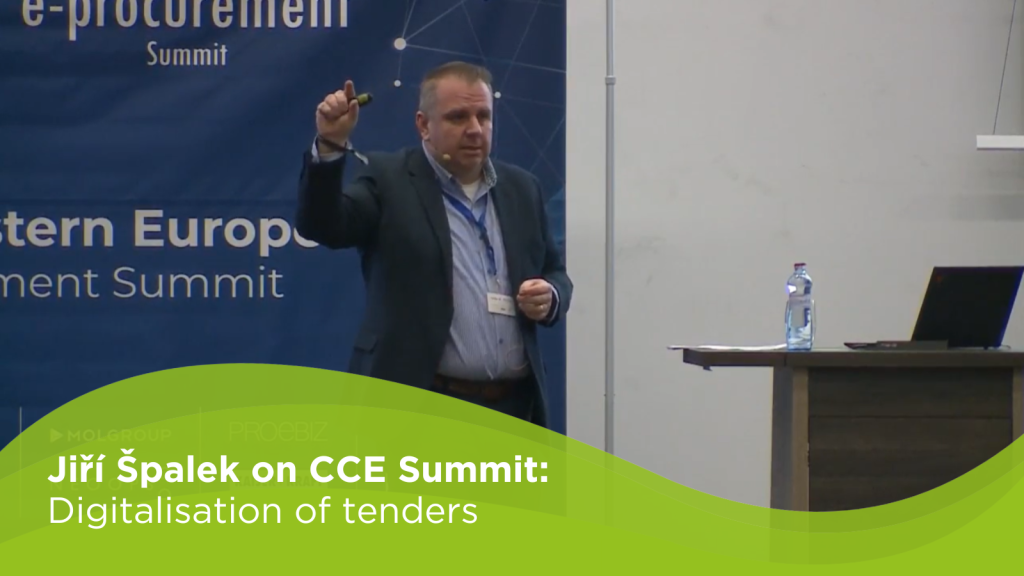
Digitizing procurement isn’t about one perfect piece of software—it’s about cleverly connecting tools. Here’s a summary of Jiří Špalek’s experience and practical tips you can use right away.
Digitization isn’t one flawless system.
It’s an ecosystem of tools that talk to each other, share data, and don’t act like loners.
This is a recap of Jirka Špalek’s talk—what works in procurement today, where companies get stuck, and how to build a digital “puzzle” that survives changes in people, priorities, and the market.
Having five systems is fine—if they share the same unified data and each does what it’s best at: requisitions & approvals, catalogs, RFX, auctions, P2P/invoicing, reporting. The critical thing is to prevent retyping across apps and stick to a single source of truth (SSOT). Best practices for SSOT stress a clear data integration strategy and mapping data flows before you start “gluing” integrations together by sheer willpower. (Stibo Systems)
Practical recommendations
- Start with a process map and a data inventory: where data originates, who owns it, where it flows, and who changes it.
- Choose integration interfaces (API/ETL) and standards for identifiers (supplier, item, project).
- Build reporting on one dataset and enable self-service use of reporting outputs for colleagues—you’ll avoid endless “could you add one more column?” requests. 😊 (ThoughtSpot)
a) User Experience (UX)
Good UX = faster adoption, less training, higher productivity. In enterprise software, UX is a key adoption factor, not a “nice-to-have.” (ipxhq.com)
b) Transparency and digital footprint
Audit trails, traceability, export options—not just for compliance, but also for security monitoring in large firms.
c) Real savings
Not just price. Count transaction costs and time. ERMMA—reverse, multi-item, multi-criteria e-auction—has its place. Public-sector studies show significant savings and multiple bid improvements during auctions. (gao.gov)
d) Performance and stability
The system must handle dozens to hundreds of tenders in parallel, with large item–supplier matrices. Plan capacity; track peak response times.
e) Security
Be clear on which data you protect and how you’ll justify their value to the security manager.
f) Reporting
Instead of endless “custom reports,” give teams access to valid data and governed self-service analytics. (GoodData)
g) Integration “without retyping”
Data should flow across applications, not be copied. Prepare an integration catalog (what, from where, how often, responsible owner). (vendr.com)
h) Support and knowledge sparring
A technical help desk alone isn’t enough. You’ll benefit from consulting support from people who understand tenders and categories and have cross-industry benchmarks.
3) Implementation without dead ends: plan, change, pilot
Digital procurement fails more often on change management than on features. Explain the “why” early, define ambassador roles, and measure adoption. A short real-life pilot (4–8 weeks) gives enough data for feedback and process tweaks, catches glitches, and speeds up the broad rollout. Organizations that emphasize change management report higher ROI and longer-term user engagement. (us.caddi.com)
Start checklist
- Goals & metrics (cycle time, compliance, time/money saved)
- Pilot scope (category, team, suppliers, timeline, risks)
- Integration plan (minimal data flows already in the pilot)
- Training “for the job,” not “for features”
- Go/no-go criteria for scaling
4) Tendering as a pillar: flexibility up front, not firefighting in Excel later
Most tenders are evaluated “as a whole,” but practice needs item-level work, groupings, rounds, and custom formulas. If your Excel can do a formula, your tool should do it too—automatically. That eliminates unnecessary manual imports/exports and the risk of hidden errors.
What to want from a tender module?
- No limits on items, groups, and rounds—real life isn’t one-shot
- Approval roles (strategy, setup, initial offers, quality, result)
- Copies and templates for repeatable buys (where they make sense)
- Export interfaces instead of static reports
When to try an e-auction
Auctions aren’t a cure-all, but when the market is competitive and the spec is clear, they bring hard savings. Meta-analyses and public-sector practice confirm this. (businessofgovernment.org)
Short and fast RFX
Start with an RFI when you don’t know the market (e.g., projectors: throw ratio, placement, lumen output—you won’t nail that without suppliers). Build the next RFQ round on facts you gathered.
Cyclical demand
For volatile categories (food in catering, commodity-linked items, energy), run weekly/3-day cycles. You’ll keep prices current and avoid locking in.
(Tip: share the cycle calendar and qualification rules in advance to reduce supplier chaos.)
With pre-qualification
Have suppliers pass pre-qualification (certifications, capacity, references) before they can submit prices. You’ll shorten evaluation and filter out “tourists” who only map competitor prices without adding value.
Staged tender
For months-long projects, add review milestones (price updates, technical changes). Track version history in the tool.
Buy–sell combination
When you’re buying and selling in one flow (waste disposal, vehicle or IT refresh), use a setup where one item goes “down” and another “up.” You get a net result calculated in one place.
6) How to run “the whole thing” in data—without a reporting hell
- Governed self-service reporting: the business answers its own questions; IT guards data quality and metric definitions. (ThoughtSpot)
- Unified specs and codes (supplier/item/project)—even with integrations, without proper order you’ll compare apples to oranges in tenders. (holistics.io)
- Open integration policy: plug in new tools without headaches (and without vendor lock-in). (vendr.com)
7) Three mini use-cases worth trying
Hospital sourcing of ingredients: switch to cyclical RFQs with a fixed calendar and a qualification barrier. In volatile food markets you keep agility—without year-long “wedding” frameworks.
IT laptop refresh: one tender, two sides—buy new and sell old (trade-in). The system can evaluate and display the net in a single table.
Construction subcontracting: multi-round with progressive qualification (HSE, capacity) and a final e-auction on commodity items. You save time and money because price competition happens on a “cleaned-up” field. (Savings from reverse e-auctions are backed by literature and public data.) (gao.gov)
Conclusion: Share experiences and assemble your own "puzzle"
No vendor invents everything.
Your edge lies in the mix—clear strategy, smartly chosen tools, unified data, and disciplined change management.
And above all—sharing. If you wait for the perfect system, the world will run past you.
Assemble, connect, test.
More practice, fewer PowerPoints.
If you want to keep the conversation about digital procurement practice going, follow the #O PROEBIZ column—we open similar topics there with people from the field.
Leave the pointless heroics to movie superheroes—procurement runs on craft, not magic.
Inspired by Jirka Špalek’s talk at the CEE Summit.