


Commodity Strategy Isn’t Theory. It’s How Procurement Stops Just Putting Out Fires
In some companies, commodity strategy has a reputation for being a document that gets created once a year, goes through a round of comments, gets a logo and…


There are several moments in a negotiation when the atmosphere in the room changes.
Someone states a number. The other side goes quiet. One participant leans back, another starts taking notes, and a third says: “We really weren’t expecting that.”
And that is exactly when you find out whether someone knows how to negotiate or merely knows how to talk.
The first two parts were about what negotiation really is and why, without preparation, objectives, and strategy, it resembles organised chaos more than anything else. Now comes the part everyone likes best: tactics.
But with one important warning.
A tactic is not a magic trick. There is no universal phrase that will instantly make a supplier cut their price by seventeen percent, extend the warranty, and thank you for the experience. Negotiation is not a collection of magic spells. It is about working with people, the environment, timing, information, and pressure.
Someone who uses tactics without understanding the situation is like a person who has been handed a set of surgical instruments and immediately decides they can perform surgery.
Technically speaking, they can. It just probably won’t last very long.
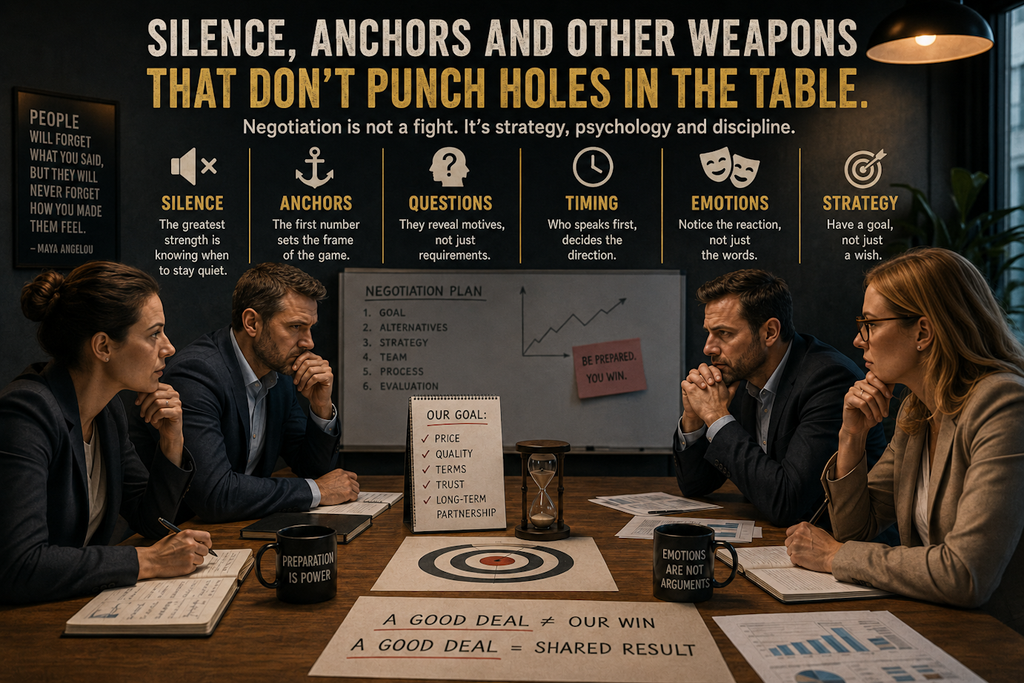
The room, temperature, time, table arrangement, noise, refreshments, or the availability of breaks may not seem like crucial parts of a negotiation.
Until they are.
Imagine a meeting in a small windowless conference room where it is thirty degrees in summer, the coffee ran out an hour ago, and one participant is sitting directly beneath an air conditioner set for an Arctic expedition.
After two hours, nobody is looking for the best deal anymore.
Everyone is looking for the exit.
Discomfort reduces patience, impairs concentration, and encourages quick decisions. And quick decisions mainly benefit the person who is not under pressure.
That is why it is worth keeping an eye on the environment. Not obsessively. Practically.
If something is clearly wrong, say so. Ask for a break, some water, a different room, or to postpone the meeting. Someone who refuses to negotiate while physically uncomfortable is not being difficult. They simply do not want to make an expensive decision because their back hurts and they are running out of oxygen.
And if you are hosting the meeting, make sure the conditions are professional.
An intentionally uncomfortable environment may create pressure. But it also sends a simple message: we don’t know how to negotiate any other way.
That isn’t dominance. It is organisational laziness disguised as psychology.
“We have an hour.”
That is not a sentence you should announce too enthusiastically.
As soon as the other side knows you are leaving for the airport in sixty minutes, your calendar becomes part of the negotiation. They do not have to persuade you. They just have to wait.
Time pressure is one of the most effective tactics precisely because it usually does not look like a tactic. It looks like an ordinary logistical circumstance.
The final ten minutes of a negotiation often produce the biggest movement. One side knows the other needs to finish. They start opening new issues, returning to matters that had already been settled, or offering a condition that can only be accepted under pressure.
And suddenly someone says:
“Let’s just close this so we can get it done.”
The phrase “so we can get it done” has probably caused more damage in procurement than many open conflicts.
Good preparation therefore includes a time buffer. A complex negotiation should not have another meeting, a train, or a family celebration scheduled immediately afterwards.
If the other side is in a hurry, we do not need to deliberately slow them down. But we should recognise that their pressure may work to our advantage.
And if we are the ones in a hurry, it is often better to pause the negotiation than to close something at 4:50 in the afternoon that we will spend the next three years explaining to our colleagues.
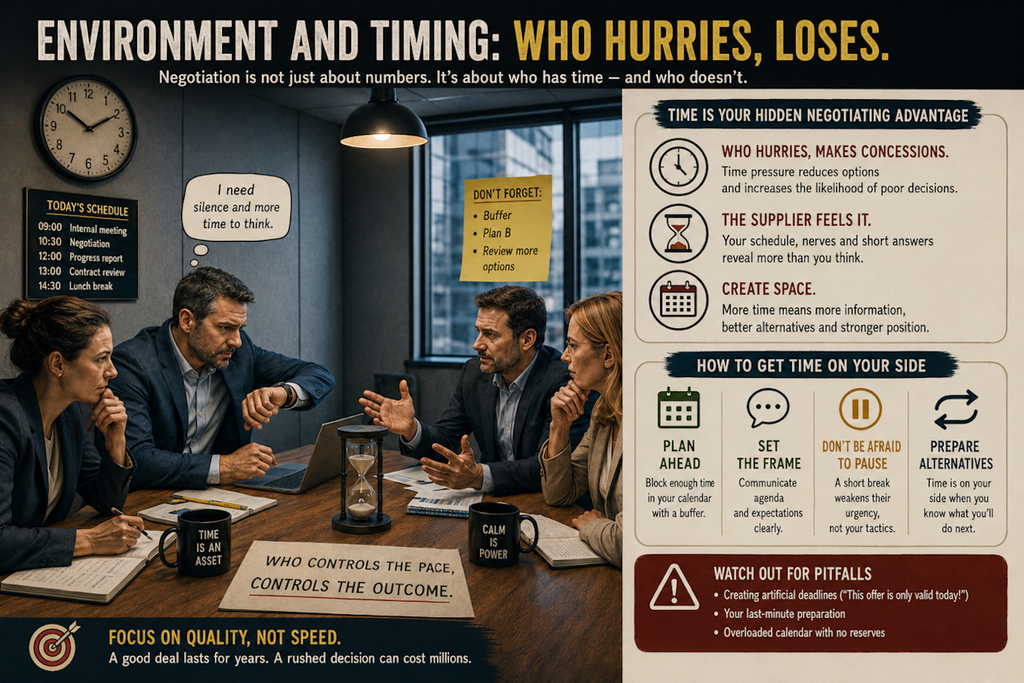
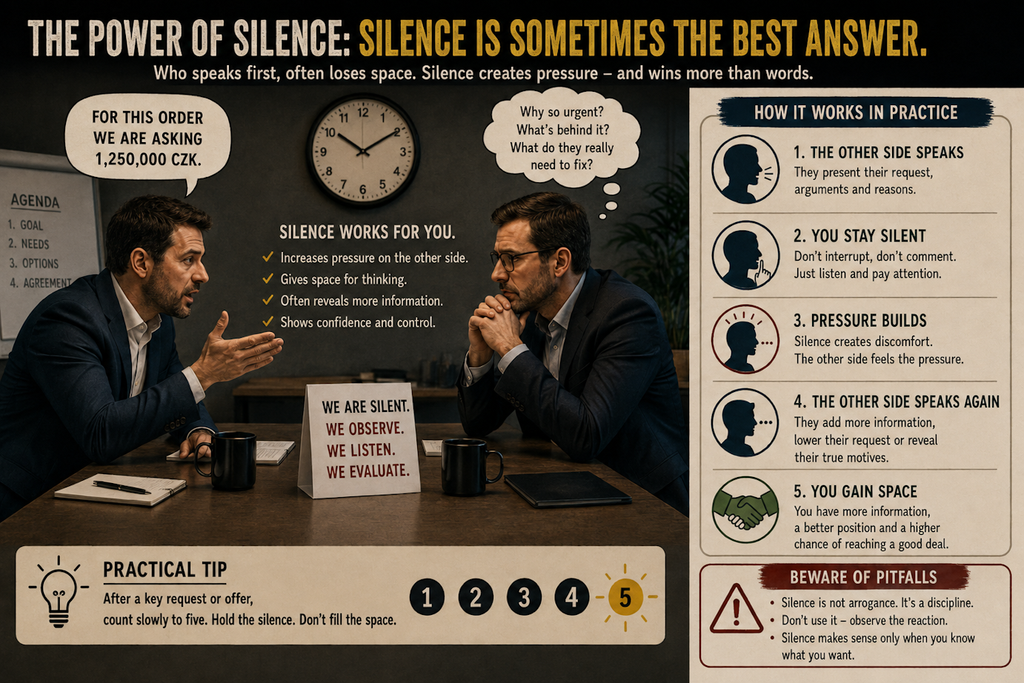
Silence is one of the simplest negotiation tactics and, at the same time, one of the hardest to use properly.
People do not like it.
They state a demand and immediately start softening it.
“We need a twelve percent price reduction… of course, we understand that the market situation is difficult… perhaps we could look at other options as well… we don’t want to put pressure on you…”
Within a few seconds, they have dismantled their own demand piece by piece and even explained to the other side how to get around it.
The right approach is usually simpler.
State your request.
And be quiet.
Silence creates tension. And tension makes people react. The other side starts explaining, asking questions, defending themselves, or looking for a solution. Often, they reveal what the real problem is.
Silence also gives weight to what has just been said. If we immediately bury it under more talking, we signal that we are not entirely confident about it ourselves.
Of course, this is not a competition in hypnotic staring. Silence needs to be natural and purposeful. It should not feel like a psychological experiment on employees.
Just remind yourself occasionally that not every second needs to be filled.
The person who talks gives away information.
The person who listens gains it.
Closed questions have their place. They help confirm a specific fact.
“Do you agree with the deadline?”
“Is the price final?”
“Do you have the capacity?”
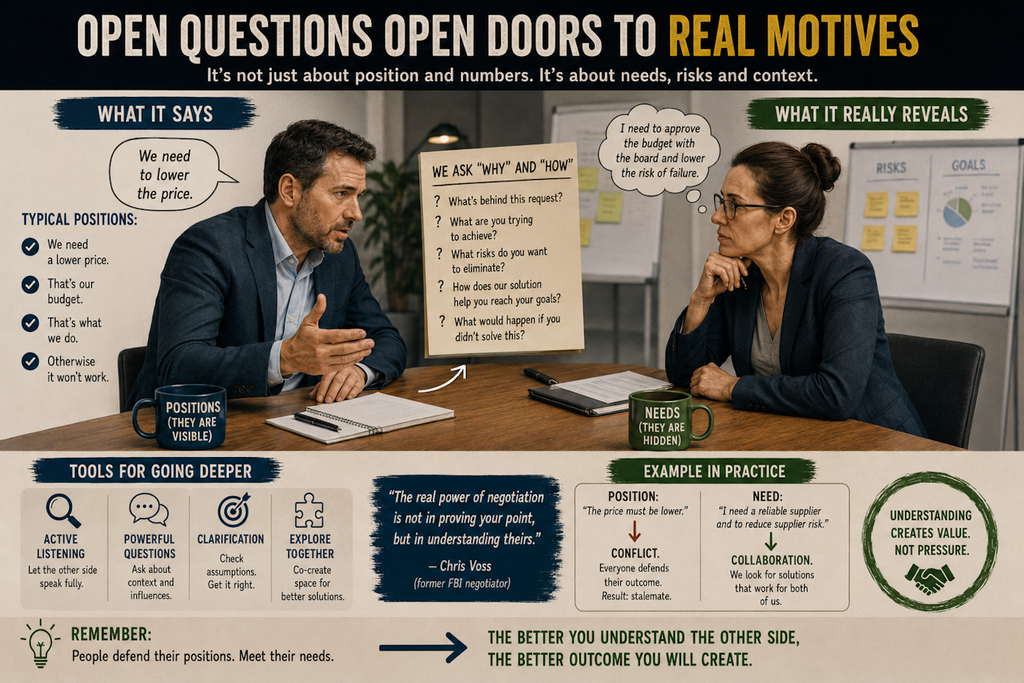
For deeper negotiation, however, open questions are far more valuable.
What is preventing you from accepting this deadline?
How would the proposal need to change for it to make sense for you?
What is the biggest risk for you in this part of the agreement?
What impact would an increase in volume have?
An open question forces the other side to explain. And explanations reveal priorities, constraints, and weak points.
Questions beginning with “what” and “how” are particularly powerful.
“Why” tends to be less useful, especially when it sounds accusatory.
“Why did you fail to meet the deadline again?” sounds like the beginning of an interrogation.
“What led to the deadline being missed?” creates room for information.
The content is similar. The emotional impact is completely different.
That does not mean being soft. It means getting an answer instead of a defensive reaction.
The supplier wants to increase the price by ten percent.
Procurement’s first reaction is understandable: reject it, ask for supporting evidence, compare the market.
That is correct. But it is not enough.
The more important question is: why exactly ten?
Is it rising input costs? Exchange rates? Energy? Lack of capacity? An attempt to recover historically low margins? Or simply an opening anchor?
Similarly, the buyer may demand a fifteen percent price reduction. Is that a realistic objective, an internal target, an expected starting point for movement, or simply a number that came out of a meeting with someone saying, “Let’s try for more”?
Numbers look objective. In negotiation, however, they often represent only the visible tip of a much larger problem.
That is why challenging the number itself is not enough.
You need to understand how it was constructed.
How did you arrive at this figure?
Which inputs have changed?
What proportion of the price is fixed?
What would need to happen for the price to come down?
How would volume, contract length, or the schedule affect the change?
Questions like these move the negotiation away from opinions and towards structure.
And structure is easier to negotiate than feelings.
A firm rejection can sometimes sound confident.
“We will never accept that.”
“We are not going to discuss that.”
“That is out of the question.”
The problem is that absolute statements also restrict the person making them.
The situation may change. New information may emerge, a different proposal may appear, volumes may change, or a countervalue that was not originally on the table may be introduced. But the person has already publicly said “never.” Now they either have to defend a bad position or make an uncomfortable retreat over their own ego.
It is much more practical to reject something more precisely.
“Under the current conditions, this is not acceptable to us.”
“In its current form, we cannot approve the proposal.”
“Based on the information currently available to us, we cannot commit to this solution.”
It is still a no.
Just not the kind of no that walls off every future possibility.
This approach is particularly important in relationships that are supposed to continue. The supplier market is not infinite, and people have the inconvenient habit of remembering how they were treated.
Sometimes even longer than they remember the contractual terms.
Past mistakes have their place in negotiation.
They need to be identified, their impact understood, and measures put in place to prevent them from happening again.
But many negotiations become stuck precisely in the past.
“Two years ago, you failed to deliver on time.”
“You changed the specification.”
“Last time, you rejected our claim.”
“Because you didn’t send us the documentation.”
And within twenty minutes, a business negotiation has turned into a family argument, just with more expensive watches.
The past cannot be changed. It can only provide information for setting things up better in the future.
That is why it is useful to redirect the conversation.
What needs to be different next time?
How will we define responsibility?
Which milestones will be monitored?
What will we do if the risk occurs again?
How will we reflect the change in the price or contractual terms?
The future creates room for solutions. The past often merely assigns blame.
And assigned blame is difficult to invoice.
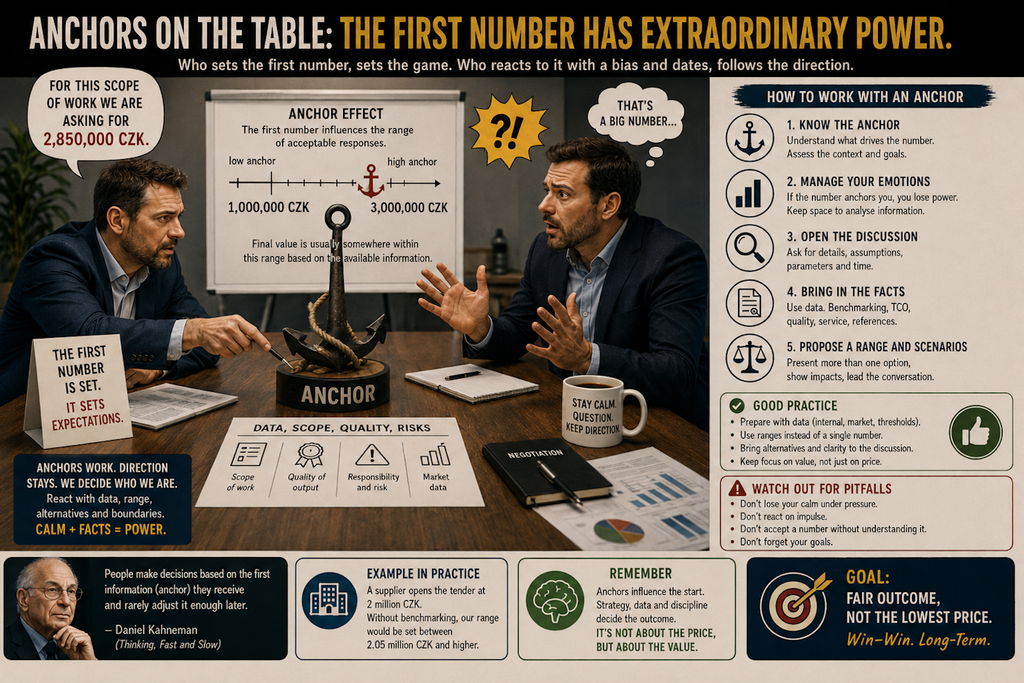
The first significant number stated in a negotiation has extraordinary power.
It creates an anchor.
From that value, the rest of the discussion, concessions, and perceptions of what is reasonable begin to develop.
If a supplier opens by demanding an eighteen percent price increase, dropping to ten percent may later look like a major concession. Even though their real target may have been eight.
Similarly, procurement may open by demanding a twenty percent reduction, creating room to end up at twelve.
But an anchor must not be absurd.
An exaggerated demand with no supporting basis can destroy credibility and push the other side into defensive mode. A good anchor is ambitious but defensible.
It should be supported by data, calculations, the market, or specific commercial logic.
Precision also plays an interesting role.
A demand for a “ten percent” reduction may sound like a general target.
A demand for an “11.7 percent” reduction creates the impression that the number is based on a specific calculation.
Of course, only if that calculation actually exists.
Inventing a precise number without evidence is simply a more sophisticated form of shooting from the hip.
A strong anchor often triggers a dramatic response.
The other side pauses, raises their voice, or says something along the lines of:
“You can’t be serious.”
Maybe we really can’t.
But perhaps we have also just hit a sensitive spot.
A dramatic reaction proves nothing by itself. It may be genuine. It may be rehearsed. It may simply be designed to make us immediately withdraw our demand.
There is no need to start defending it with a long monologue.
It is better to remain calm and ask:
What exactly is unacceptable about our proposal?
Which assumption do you believe does not reflect reality?
What solution would you consider defensible?
This transfers responsibility for the next move to the other side.
Shock is an emotion.
What we need is information.
When the other side asks for something and we immediately agree, something strange can happen.
Instead of satisfaction, suspicion appears.
“If it was that easy, shouldn’t we have asked for more?”
A quick concession reduces its perceived value while simultaneously creating an expectation of further concessions.
That is why concessions should be given gradually, explained, and always linked to something in return.
“If we accept longer payment terms, we need a price adjustment.”
“If we extend the contract, we expect guaranteed capacity.”
“If we compromise on the deadline, we need firmly defined milestones.”
A concession should have a price.
Not necessarily a dramatic one. We do not need to sigh every time we make a move as though we are selling the family silver.
But it should be clear that the change means something.
A particularly bad habit is making several concessions at once. The other side then cannot tell how much each one is worth, and the package begins to look like the new starting point.
Concessions should be smaller, gradual, and ideally decreasing.
This signals that we are approaching our limit.
When we recognise a tactic, we are often tempted to say:
“I know exactly what you’re doing.”
That usually gets us nowhere.
The other side denies the tactic, the atmosphere deteriorates, and the negotiation becomes personal.
It is better to neutralise the tactic.
If someone puts us under time pressure, we slow down.
If they use an extreme anchor, we bring the discussion back to the data.
If they keep introducing new demands, we start packaging the conditions together.
If they invoke the authority of someone who “will never approve this upstairs,” we ask who has decision-making authority and what conditions are required for approval.
If they claim the offer is valid today only, we do not need to prove that it is pressure. We can simply say that we are unable to make a decision within that timeframe and therefore will not accept the offer.
A tactic works mainly when we react to it automatically.
Once we identify it for ourselves, its power decreases.
Corporate procurement often has greater room to work with commercial terms, alternatives, and exchanges of value.
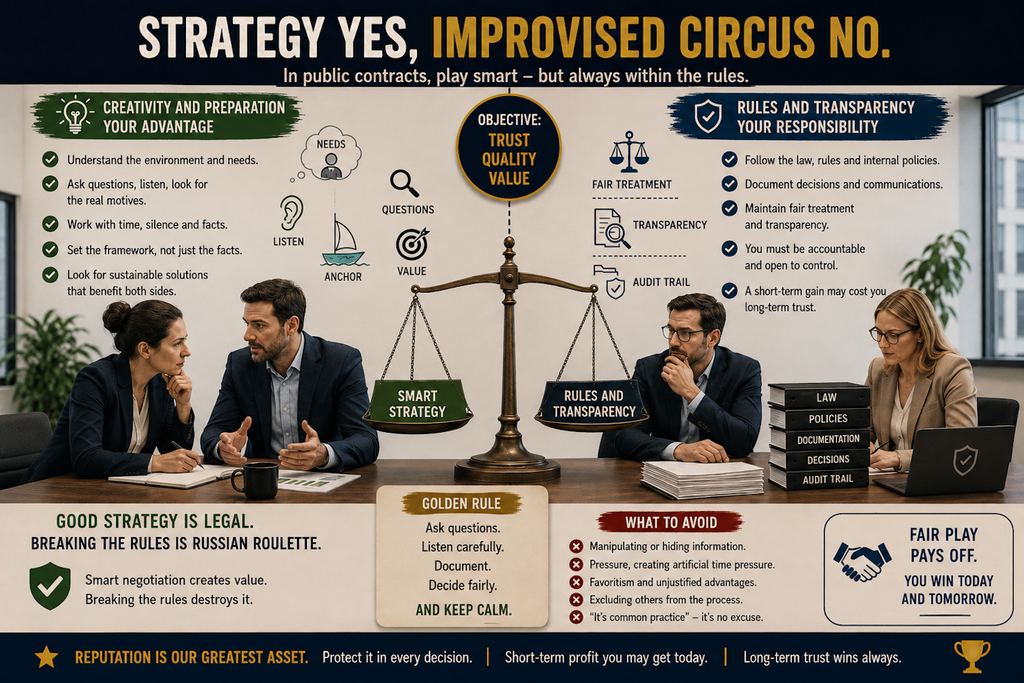
In public procurement, the situation is stricter.
Any room for negotiation depends on the chosen procedure, the tender conditions, and the rules protecting transparency and equal treatment.
But that does not mean negotiation tactics have no place in the public sector.
They do. They simply need to be used where they are permitted and in a way that can be explained afterwards.
Working with questions, preparation, proper timing, reading reactions, precise wording, or the ability to walk away from a bad deal are not forbidden forms of magic. They are part of professional practice.
The problem begins when someone confuses tactics with creative interpretation of the rules.
In corporate procurement, a clumsy sentence can damage a relationship.
In public procurement, it can also create a document that may one day be read by someone with a completely different sense of humour.
Good negotiators try to understand the other side.
This is sometimes mistakenly seen as weakness.
“If we understand the supplier too much, we’ll go soft.”
We won’t.
We will simply know what drives them.
Understanding that a supplier needs a longer contract because they have to invest in capacity does not mean automatically giving them one.
It means we have identified something of value that can be traded.
Understanding that a supplier rejects a penalty because they depend on our planning does not mean removing the penalty.
It means we need to define responsibility more precisely.
Empathy is not agreement.
Empathy is information.
And information is one of the few things you can never have too much of in a negotiation.
Negotiation is often described using the language of combat.
Win. Defeat. Push. Crush.
But a good agreement is not a sporting result.
If the other side leaves feeling humiliated, the contract may be signed, but the relationship is already starting with a debt. The supplier will be more cautious next time, less open and far less willing to go the extra mile.
That does not mean everyone has to leave delighted.
Negotiation naturally involves tension and concessions.
But both sides should leave feeling that the agreement makes sense and that they can work with it.
That is why the best negotiators are rarely the loudest.
They are prepared. They pay attention to the environment. They work with time. They know how to stay silent. They ask questions. They read reactions. They do not surrender to the first dramatic gesture, and they know that every “no” does not have to be the final one.
Most importantly, they do not confuse toughness with professionalism.
Anyone can shout.
Staying calm when the atmosphere in the room gets tense requires a certain level of skill.
Because ultimately, negotiation is not a showcase of tricks.
It is the ability to understand what is happening, why it is happening and what we are going to do next.
Everything else is just theatre.
Sometimes impressive, sometimes expensive, and sometimes so bad that you would rather leave during the interval.
Strongly inspired by the #Negotiation series, featuring guests: #MartinPokorný, #MartinZelinka

In some companies, commodity strategy has a reputation for being a document that gets created once a year, goes through a round of comments, gets a logo and…
Negotiations often go wrong before the participants even sit down at the table. Not because of a bad offer. Not because of an aggressive supplier. And usually not…
Burnout rarely arrives with dramatic music playing in the background. It usually does not begin with a collapse, a resignation letter placed on the desk, or the words,…

Privacy Policy here.

